Gods and Planets in Twenty Traditions
Copyright © 2013, 2014, 2015, 2023 by William Orchard
12/13/13
Revised 3/23/14, 6/2/15, 4/13/23, 1/29/25
CAVEAT
This essay is inspired by science but I have gone out ahead of the current scientific understanding. I believe that science will eventually catch up with me, but I am willing to call it a work of imagination for now. I also believe, a priori, that my work is flawed. My hero, Immanuel Velikovsky, also made mistakes. You are welcome to give me your opinion if you think you can improve it.
Introduction: Simple Ideas
The idea that the Sun revolves around the Earth was simple and it fit what we could see. It was only when astronomers plotted the movement of the planets that complexity set in. That complexity grew until it was unsustainable, and Earth at the center of everything stopped being the best explanation of the Solar System.
The idea that all matter came into existence in a single instant is simple, but it too has turned into an increasingly complex problem. How large a sphere would it take to hold all the matter that exists? I don’t know, but whether the radius of the sphere is one light year or a million light years, that is how long matter has to wait until it forms, and then it has no room to move around.
The next problem with matter is how rocky planets, satellites and comets are formed. At present we believe that hydrogen and helium from the Big Bang formed stars, and stars created more complex atoms through nuclear fusion. Then the stars exploded, and nebular clouds of atoms formed more stars and rocky planets. This means that all the spheres in our Solar System formed at the same time. Unfortunately, the spheres in our Solar System don’t behave like they were all formed at the same time.
There is a simple explanation that is as unpopular as the heliocentric cosmos was in the sixteenth century. Electromagnetic galaxies form all the time and electromagnetic stars form in galaxies. Stars are spheres of plasma that create matter by pinching positive and negative Birkland currents into neutrons. Neutrons decay into protons and electrons and form the elements and isotopes of the Periodic Table. Spheres of matter form inside spheres of plasma, and the spheres of matter are ejected.
The idea that life forms change slowly over millions of years is a simple idea that countered the Biblical ideas of the early nineteenth century. This idea has also become increasingly complex. There are not enough billions or even trillions of years to create complex strands of DNA by random mutation. We now know that genes are turned on and off by internal and external triggers.
Bypassing the question of how DNA is created in the first place, the simplest explanation for evolution is mutation through external triggers, i.e., intense electromagnetic energy. There is vast electromagnetic potential in the spheres of the Solar System. When spheres encounter each other, the neutral state that surrounds them at rest is stripped away and they are subjected to plasma discharge.
We do not currently believe in a gene for written language and civilization, even though that is the simplest explanation for the sudden appearance of written language and civilization around the world. We believe that societies like Sumer and Egypt are thousands of years older than societies like Japan and the Aztecs. This is because we believe the hyperbole ancients wrote about themselves and we have the cultural bias not to look for more antiquity in younger societies. Current revisions of ancient history put the starting point for written language and civilization much closer to the present. The oldest civilizations are younger than we believe and the youngest civilizations have traditions that go back to a common starting point.
According to the ancient myths of societies around the world there was a common starting point, which was the event that turned on the gene for written language and civilization. After that starting point was a series of cataclysms that affected the entire world. These cataclysms are recounted in mythical and religious traditions, and that is what I want to share in this essay.
* * * * *
The life forms of today and the topography of the Earth are the result of many cataclysms. Field researchers have identified one hundred and one geological boundaries since the Cryogenian Period (850-635 million years ago). Thirty-six of these boundaries represent a mass extinction or a sudden climate change. The Cryogenian Period itself represents a cataclysm: Earth was so far away from a source of warmth that it became encased in ice. I do not think it is unreasonable to imagine Earth being bounced around the Solar System and subjected to one cataclysmic event after another. I believe it is the nature of creation for cataclysms to occur.
In the currently accepted cosmology, all matter was created in an instant. Stars and planets formed by accretion, and stars convert matter into energy through nuclear fusion. However, there is a theory gaining acceptance in which electromagnetic energy is constantly appearing. Stars begin life as energy and turn energy into matter. In my theory, a sphere of matter forms within a sphere of plasma. This is a two-step process: a star forms a gas giant pregnant with matter and ejects it; the gas giant forms a rocky sphere and ejects it. In our Solar System, the Sun ejected Jupiter, Saturn, Uranus and Neptune, and these gas giants ejected the planets, moons and comets.
Our story begins with the ejection of Uranus or Neptune and one of them is our birth mother. For millenia Earth revolved around its birth mother until the next gas giant was ejected and captured it. Uranus and Neptune were large gas giants and they depleted themselves by ejecting satellites and comets. Earth’s capture and the ejection of satellites and comets by Uranus and Neptune produced a sequence of changes in Earth’s life forms and topography.
Long before there were humans able to record it, Jupiter was ejected and became our primary star. For millenia Earth revolved around Jupiter and endured the births of Mars, Mercury, the four Galilean moons, and an eighth satellite that was later destroyed. Like Mercury and Mars, the eighth satellite had many names and I call her Rhea.
There were creatures in our hominin tribe who endured these cataclysmic encounters, and it took many inundations of electromagnetic energy to bring modern humans into existence. The first creature that remotely looks like us is Homo habilis, who made crude stone implements called Oldowan. The next creature is Homo erectus, who made slightly more sophisticated stone implements called Acheulean. The difference between these two creatures and their implements is probably as clear as it will ever get in the study of human evolution. Importantly, they represent a cataclysmic leap from one species and technology to the next. After Homo erectus the path to Homo sapiens is less clear, but it will entail cataclysmic changes to one or more of our ancestors’ DNA.
At the end of the Upper Paleolithic Period was a cataclysmic event, probably the ejection of Rhea, which sent Earth and Rhea out of Jupiter orbit into orbit around the Sun. This was the beginning of the Neolithic Period, where a new version of Homo sapiens developed a different and creative lifestyle. We farmed crops and herded livestock; we ground grain and made implements of wood, bone, ivory, and stone. We built impressive settlements like Gobekli Tepe, but we did not have written language or even proto-language. There are no hieroglyphs at Gobekli Tepe, only carvings of animals. I think life was good during the Neolithic Period, but it was about to change forever.
The Neolithic Period ended in the Late Neolithic collapse, which is unexplained in current archaeological theory. The reason it is unexplained is because cataclysm is not part of our scientific understanding. There will be four more period collapses and four more cataclysms in this story. The Late Neolithic collapse was caused by the ejection of Saturn and the capture of Earth and Rhea. Before Saturn was ejected the Sun put on a spectacular display of plasma effects called Peratt instabilities. At this point, humans had sound associations and could communicate wants and needs, but we could not communicate abstractions. What we could do is inscribe what we saw as petroglyphs, and these incised rock carvings called “squatter man” are found all over the Earth.
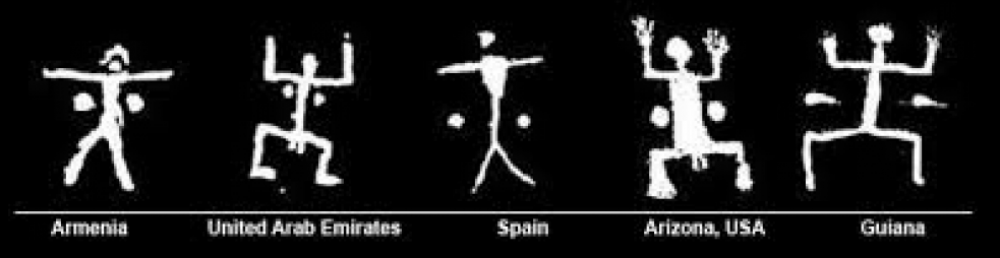
PETROGLYPHS OF SQUATTER MAN
Saturn approached Jupiter and captured Rhea and Earth in its gravitational sphere. Jupiter and Saturn were evenly matched in mass, which created an equilibrium that held Rhea and Earth in tidal lock. Saturn’s capture of Rhea and Earth caused a cataclysm that once again changed life forms and topography. The survivors could not tell their children what happened, but their children were a different kind of human being. The new generation was born with increased self-awareness and the ability to learn how to record their experience. They must have seen the petroglyphs of squatter man and related images left by their ancestors, but they did not relate to them. That is why there is no mythology associated with squatter man.
This new chapter in human evolution is the beginning of the Chalcolithic Age. In mythology it is called the “Golden Age” because it is when humans learned to extract copper, silver, and gold.
This is the configuration of the Golden Age. Uranus and Neptune were already banished to the outer reaches of the Solar System:
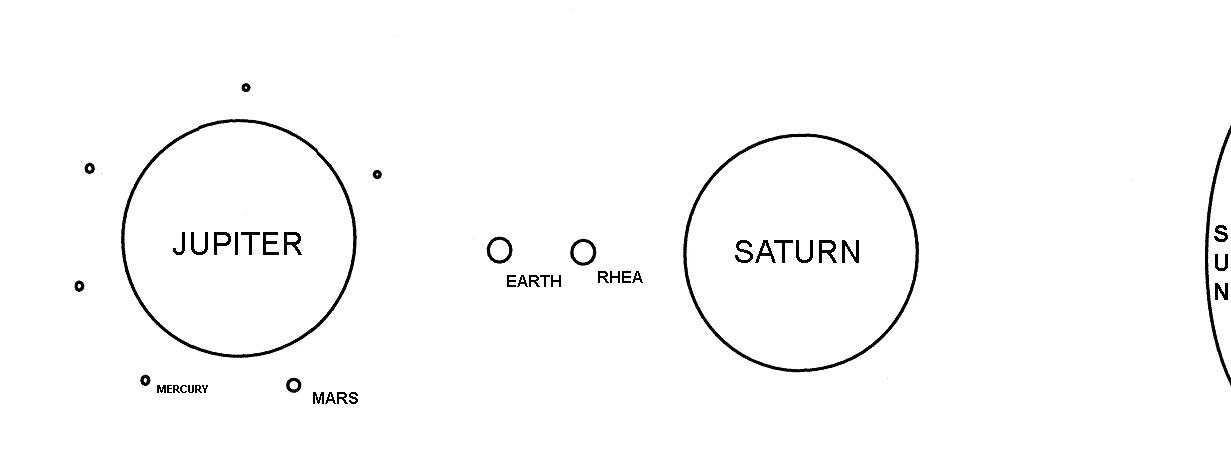 GOLDEN AGE CONFIGURATION
(Click on picture to enlarge)
During the Golden Age Jupiter and Saturn revolved around the Sun in synch. The northern hemisphere of Earth always faced Saturn and Earth’s rotation produced no diurnal periods; there were no seasonal changes. We received indirect light and warmth from the Sun and some warmth and light from Saturn. The southern hemisphere was in the shadow of both Saturn and Earth and received no sunlight. It was uninhabitable and probably helped shape our imagination about the Underworld. The children of the survivors of Saturn’s capture looked at the world in wonder and discovered that everything had a name. They saw an enormous disc in the sky and called it Saturn. They saw a smaller disc in front of Saturn, decided it was Saturn’s mate, and called it Rhea. They also gave Saturn and Rhea job descriptions and honorifics, which morphed into names as language and the Solar System evolved. The Golden Age ended in a cataclysm called Doomsday, which caused a change in many of Saturn’s and Rhea’s names.
There is an abundance of support for this scenario in the mythology of the world. I researched twenty well known world mythologies and in nineteen of them I came up with these pairings.
1 – SATURN AND RHEA
Greek – Kronos and Rhea
[Minoan tradition perceived Saturn as the Great Goddess, unlike any other tradition I have studied. Rhea was known as Britomaris, the Mistress of Animals (also called Diktynna), but there was also a Master of Animals. This alter ego of Britomaris was consort to the Great Goddess. After the Doomsday cataclysm, Minoan tradition gave way to Greek tradition, and there was no place in Greek tradition for a Great Goddess equal to Kronos. Greek tradition did incorporate the male/female alter ego paradigm of Britomaris, who became a goddess without a sphere, since the Greeks already had Rhea. The Greeks called her Artemis, and her alter ego brother was Apollo. The Romans called her Diana, and her alter ego brother was also Apollo. However, Diana (Jana) had another alter ego in Janus, who became a Roman god without a Greek counterpart]
Roman – Saturn and Ops
Norse (Germanic) – Odin (Wotan) and Frigg
Irish – Elatha and Ethniu for the Fomorians
Elatha and Danu for the Tuatha De Danann
[When Ireland became Christianized its myths were cleansed of any sense of reverence. The Irish gods became legendary heroes, and without a sense of worship it is difficult to gauge how important each deity was. Irish myths that resembled events in the Bible were purged. Irish tradition was also complicated by the legendary Irish penchant for quarreling. The Irish appear to have been divided over the name of Rhea, and two traditions competed with each other. These traditions mocked and appropriated mythical elements from each other. One tradition, the Tuatha De Danann eventually prevailed by killing off the gods of their rivals, the Fomorians. The name ‘Fomorian’ means ‘monster,’ a name almost certainly chosen by the Tuatha De for their rivals.]
Egyptian – Atum and Iusaas before Doomsday
Osiris and Isis after Doomsday
[Egyptian cosmology is different from other Middle Eastern traditions because Egyptians worshipped the Sun rather than Jupiter. Atum (Saturn) was also known as Ra, and Ra became Sun after Doomsday (This is true of most ancient traditions: a secondary name for Saturn became the name of the Sun). In other traditions the dynamic between Jupiter and Saturn (see section 8) is clearer because Sun was a lesser deity.
Iusaas was the original “eye of Atum” as Rhea suspended in front of Saturn. After the Doomsday cataclysm, Iusaas morphed into Isis and Iusaaset and had two identities. As Isis (Rhea), she played a continuing role in the cosmological drama. As Iusaaset she became entirely mythical and was known as the “eye of Ra,” an honorific given to several deities.]
Sumerian – Enlil and Ninursag (also Ninlil)
Babylonian – Enlil (also Ashur) and Ninlil
Hurrian/Hittite – Kumarbi and Hebat/Hannahannah
[Kumarbi and Hebat/Hannahannah have the right attributes for Saturn and Rhea but there are no stories linking them together as mates. Kumarbi (equated in the ancient world with Enlil and El) bit off the testicles of his father, Anu (Uranus) and became pregnant.]
Canaanite – El and Elat (also Asherah)
Hebrew – El unmarried
[Rhea was considered an Archangel after the Doomsday event (see section 5). Eve (Rhea) and Adam (Saturn) were married in Genesis. Note the similarity between Hebrew ‘Adam’ and Egyptian ‘Atum.’]
Arabian – Pre-Islamic Arabian tradition may have gone back to Saturn and Rhea, but Islamic piety purged the ancient tradition of much of its polytheism.
Persian – Zurvan and Mother Goddess (usually conflated with Anahita)
[Ahriman (Saturn after the Doomsday cataclysm) became the embodiment of evil in Persian tradition. Consequently, Zurvan (Saturn before the Doomsday cataclysm) was theologized into an androgynous progenitor (cf. Kumarbi in Hurrian/Hittite tradition) and the name of his mate did not survive the transition. Nevertheless, Persian tradition has a Mother Goddess like every other tradition in the region (and similarly conflated with the goddess of love and fertility). It is possible that she was called ‘Nahid’ as distinct from ‘Anahita.’ Just as Ahriman was the embodiment of evil, Ahriman’s consort Jahi (Rhea) also became an embodiment of evil.]
Hindu – Brahman and Devi (theologized into Brahma and Saraswati)
Maya – Itzamna and Ixchel
Aztec – Ometecuhtli (Tonacatecuhtli) and Omecihuatl (Tonacacihuatl) before Doomsday
Tezcatlipoca and Coatlicue after Doomsday
[After Doomsday Tezcatlipoca became Black Tezcatlipoca (Jupiter) and Red Tezcatlipoca (Saturn in his new identity). After the Deluge Tezcatlipoca also became White Tezcatlipoca (Quetzalcoatl/Mercury) and Blue Tezcatlipoca (Huitzilopochtli/Mars).]
Inca – Viracocha (also known as Kon Tiki) and Mama Qucha
Sioux – Ksa and Unk
[Ksa was the primordial deity born from the cosmic egg. However, all we know about Ksa is that he invented language, stories and names, and was an earlier manifestation of Iktomi (Saturn after the nova, see section 13). Sioux tradition had Sky and Earth deities, but they did not have a sacred time or place when Ksa reigned supreme. Unk did not like Ksa, but she was clearly Rhea (see section 10).]
Chinese – Huangdi and Leizu
Japanese – Izanagi and Izanami
Hawaiian – Ku and Hina
Rhea was often conflated with Moon. The ancients conflated Rhea because she ceased to exist after the Deluge, and later generations forgot the origin of their mythology. Modern researchers conflate Rhea with Moon because there is no other sphere to consider.
The cosmology of the Golden Age was simple: There was the sky, which the Greeks of the Golden Age called Uranus. There was Saturn, an enormous disc that filled the sky, and Rhea, a smaller disc that hovered in front of Saturn. Finally, there was the Earth, which the Greeks called Gaia. We need to remember this because every tradition has mythical lineages for generations of primordial deities. Our ancestors learned how to name things, but they also learned how to confuse themselves with emotional thinking. All traditions are muddled about the beginning, but some of the twenty traditions give a clear picture of sky and Earth:
2 – SKY AND EARTH
Greek – Uranus and Gaia
Roman – Caelus and Terra
Irish – Ernmas (Earth Mother, see section 6)
Egyptian – Nut and Geb
Sumerian – An and Ki
Babylonian – Anshar and Kishar
Hurrian/Hittite – Anu (Sky god)
Maya – Hunab Ku (Sky god)
Inca — Pachamama (Earth)
Aztec – Ometeotl (Sky god)
Sioux – Skan and Maka
Hawaiian – Wakea and Papa
In addition to naming themselves, the plants and the animals, the people of the Golden Age named the ocean, the light, the directions, and speech itself. These names were remembered and in Greek tradition they would be configured as Titans. However, during the Golden Age there was no need for a creation myth because very little happened. The weather was warm and there were no dramatic temperature changes. The ground was watered from a constant mist and food was abundant. Humans had not much to do but explore the world and develop their minds.
Our unusual rotation made Saturn appear to turn like a wheel in the sky, and Saturn and Rhea put on a variety of spectacular sights. Rhea stayed in place because of tidal lock and appeared to be the eye of Saturn. The Sun, which we never saw, changed Saturn’s appearance. Sometimes there was a crescent on Saturn that looked like a sickle or the horns of a bull. The diffusion of light behind Rhea gave the appearance of rays or stars with four, six or eight points. Plasma emanating from Saturn made it appear that there was a connection between Earth and Saturn, which our ancestors saw as a world mountain or tree. We did not see Jupiter or any of Jupiter’s satellites. We captured these images in paintings and petroglyphs, and even though we were learning how to tell stories, there was not much of a story to tell.
Eighteen of the twenty traditions have a sacred time or place, or a residence of the gods. In many of the ancient creation myths, the end of the Golden Age was described as its beginning.
3 – SACRED TIME AND PLACE
Greek – Time: Golden Age – Place: Arcadia
Roman – Time: Golden Age – Place: Arcadia
Norse – Time: Golden Age – Place: Midgard/Asgard
[Midgard was the realm of humans and Asgard was the realm of the gods. The realms were connected by a bridge. There was also a sacred tree named Yggdrasill.]
Irish – Place: Eriu
[Elatha (Saturn) visited Eriu (the original name for Ireland) at night on a silver boat. Eriu became the Fomorian Moon goddess after the Doomsday cataclysm, but in this story Eriu refers to a place. Eriu comes from a word meaning “land of abundance.”]
Egyptian – Time: Tep Zepi (first time) – Place: Sekhet Hetep
Sumerian – Place: Dilmun
Babylonian – Place: Dilmun
Hurrian/Hittite – Place: Kummiya was the city of the gods. Kuntarra was their temple.
Canaanite – Place: Eden
Hebrew – Place: Eden
Arabian – Arabian tradition started after the Deluge.
Persian – Place: Airyana Vaejah
Hindu – Time: Satya/Krita Yuga – Place: Mount Meru
Maya – Place: Yax Imix Che (world tree), also known as Wacah Chan
Aztec – Place: Tamoanchan
Inca – The Inca inherited their tradition from pre-Inca societies. Many of the most ancient myths did not survive Inca modification of the narrative. There was a sacred place named Hanan Pacha (the world above), where the gods lived.
Sioux – Inyan was the solid support of the Earth created as one of the four superior spirits along with Sky (Skan), Earth (Maka) and Sun (Wi, who was probably a generic “sun” name for Ksa). His name is translated as “Rock.” I believe Inyan was the name for the World Mountain that appeared to connect Saturn and Earth.
Chinese – Place: Kunlun
Japanese – Place: Onogoroshima
Hawaiian – Place: Kane-huna-moku (also known as Ulu-koa)
[The Hawaiian sacred place was named for Kane (Jupiter) rather than Ku (Saturn). In Hawaiian tradition Ku is more ancient than Kane but he is subordinate in power. Hawaiians have another “garden of Eden” (Paliuli) which was accepted as such by Christian missionaries. Paliuli appears to be another name for the “hidden land of Kane”]
One day our ancestors saw a long trail of cloud and fire (cf. Gen 3:24). Saturn had just ejected what would become our Moon. Then everything turned to chaos and darkness. Saturn and Jupiter changed places with respect to the Sun and we were released from tidal equilibrium. This was the Late Chalcolithic collapse, which launched the Early Bronze Age.
This was the new configuration of the Solar System:
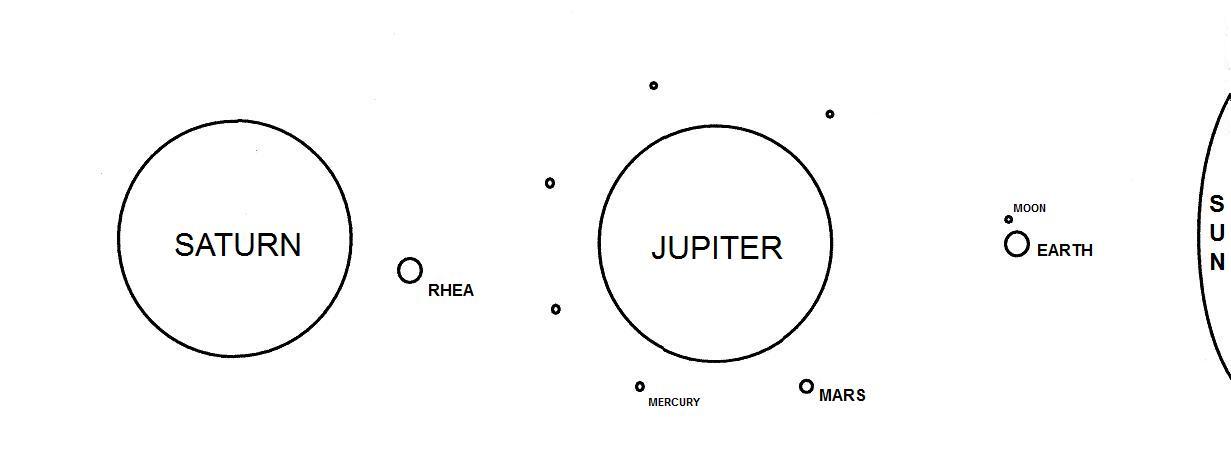
DOOMSDAY CONFIGURATION
(Click on picture to enlatge)
This time the survivors could tell their children what they saw and what they thought had happened, but the new reality was unbelievably different than the old reality. In trying to understand it our ancestors conflated the experience of the Golden Age, the cataclysm that ended the Golden Age and the new reality they lived in. The Greeks invented a story that Saturn used his crescent sickle to make the trail of cloud and fire and that he had castrated his father, Uranus. Eighteen of the twenty traditions have stories about a monster that punctuated the end of the earliest age, or the age of the gods, or a sacred time and place.
4 – THE DOOMSDAY MONSTER
Greek – Ophion
Roman – Ophion
Norse (Germanic) – Nidhogg
Irish – Oillipheist
[There are several mythical serpents and dragons in Irish tradition. With the Christianization of Irish tradition, St. Patrick was given credit for driving these mythical monsters out of Ireland. Oillipheist is the most likely candidate for the Doomsday monster because he was described as a giant worm rather than a dragon.]
Egyptian – Apep/Seth
Sumerian – Nammu
Babylonian – Tiamat
Hurrian/Hittite – Hedammu
Canaanite – Yam
Hebrew – Behemoth.
[Behemoth lived in an invisible desert outside the Garden of Eden. He was portrayed in Jewish tradition as a monster of the future rather than the past. (The serpent in Genesis is a theologized version of the Doomsday monster, morally destructive but not physically destructive).]
Arabian – Arabian tradition started after the Deluge.
Persian – Ahriman
Hindu – Sheesha, seen as a helpful serpent rather than a destructive one.
Maya – Vision Serpent
[Vision Serpent was also known as Kukulkan and Gucumatz. This serpent was seen as a partner in creation.]
Aztec – Ehecatl/Queztalcoatl, also seen as a partner in creation.
Inca – Inca tradition does not speak of a Golden Age or a Doomsday cataclysm. Pre-Incan societies could not have lived south of the equator during the Golden Age. What is now Peru shifted to its current location during the cataclysm. Any myths about a Golden Age did not survive.
Sioux – Iya
[Sioux tradition does not describe a Golden Age. Iya was a primordial monster, the offspring of Unk (Rhea) and Inyan (see section 3).]
Chinese – Chi You
Japanese – Watasumi
Hawaiian – Mo-o-Inanea
There were three cataclysms in the history of Earth involving comet-like trails (Doomsday, Deluge/Caduceus, and Venus). The ancients invented mythical monsters to explain these cataclysms and used the same monsters over and over. Sometimes the new monsters were conflated back into older myths.
After the Doomsday cataclysm Earth rotated on a tilted axis and the new humans saw the Sun for the first time. The Earth also revolved around the Sun and there were seasonal changes. A new planet sun had replaced the former one, but the old planet sun and its mate could still be seen in the distance. The new planet sun had six satellites that were often seen as children of the old planet sun. The Greeks invented a story that Saturn had eaten his children then disgorged them. In some other traditions, the children were Jupiter’s. The six satellites of Jupiter were Mercury, Mars, and four Galilean moons that never left orbit or did anything to distinguish themselves. When the ancients named them as a group of six deities (or four deities after the Deluge) we can assign them to Jupiter. This is not the case in all twenty traditions. Here are the ones I can identify:
5 – THE SATELLITES OF JUPITER
Greek – The six children of Kronos (other than Zeus) were Poseidon, Hera, Hades (probably Ares), Demeter, Hestia, and Chiron. Hermes (Mercury) and Ares (Mars) were not distinguished until they went into orbit around the Earth and were given lineages as children of Zeus (Jupiter). Chiron appears after the first five children, possibly a function of its smaller size. (The smallest Galilean moon, Europa, is only 10% of the volume of Mars)
Roman – Roman tradition mirrored Greek tradition. The six children of Saturn (other than Jupiter) were Neptune, Juno, Pluto (probably Mars), Ceres, Vesta and Chiron. Mercury and Mars were given lineages as children of Jupiter.
Norse – The Norse identified six sons of Odin (other than Thor): Baldr (Mercury), Tyr (Mars), Heimdall, Bragi, Hodr and Vidar. Hodr will be significant in the death of Baldr. After Baldr’s death, two more sons of Odin, Hermod and Vali, appeared but this pertains to events after the Thunderbolt.
Irish – The Tuatha De Danann name for Jupiter was “The Dagda,” which refers to a plural entity. The Dagda had four children not counting Brigid (Venus): Aengus, Bodb Derg, Carmait and Midir.
Egyptian – The Egyptian lineages are not as supportive of my scenario as I would like. I believe the Egyptians used the six satellites of Jupiter in a convoluted creation scenario around Atum/Ra/Osiris, who were all the same planetary deity (Ra became the Sun after Doomsday). Anubis (Mars) was the son of Osiris. Thoth (Mercury) was self-created but was also regarded as the son of Ra (Thoth was also known as Ptah, who was conflated back into the creation scenario as the father of Atum). Shu and Tefnut were the children of Atum and the grandparents of Osiris. Nephthys was Osiris’ sister. Bastet was Ra’s daughter.
Sumerian – The six children of Enlil (other than Ninurta and Nanna) were Enki (Mercury), Nerigal (Mars), Nisaba, Pabilisag, Enbilulu and Namtar.
Babylonian – Babylonian tradition mirrored Sumerian tradition. The six children of Enlil (other than Ninurta and Nanna/Sin) were Nabu (Mercury), Nergal (Mars), Nisaba, Pabilisag, Enbilulu and Namtar.
Hebrew – Hebrew tradition considered El to be unmarried, therefore he had no children. The Hebrews combined the six satellites of Jupiter plus the one satellite of Saturn (Rhea) into a tradition of seven archangels, whose names changed across the centuries.
Persian – Persian tradition considered the six satellites of Jupiter to be six divine sparks (Amesha Spenta) of Ahura Mazda.
Hindu – The eight lesser Devatas were Surya (Sun), Chandra (Moon) and six others. These six were Indra (Mars), Agni (Mercury), Varuna, Yama, Kubera and Vayu.
Hawaiian – Haumea was the female alter ego of Kane (Jupiter). The children of Haumea (some by Kane and some by other deities) were Kapo (Mars), Pele (Mercury), Kane Milohai, Kamohoalii, Namaka and Hi’iaka.
After the Doomsday cataclysm, our ancestors saw Moon for the first time in all its glory. In all twenty traditions it is clear that Moon had a unique origin, either from Saturn or from Uranus (Sky). Moon was closer to Earth than now and it had a pronounced effect on sexuality. Consequently, Moon was originally a love and fertility deity, usually a goddess with a male alter ego.
Many people will find it hard to believe that the Moon is less than four thousand years old. However, the nebular accretion hypothesis of the formation of the Solar System is not universally accepted. The ejection of gas giants and rocky planets explains the unique rotations and revolutions of the planets and satellites, as well as the momentum of comets. One has to ask how the Moon could still have a molten core after four and a half billion years. The lava of a volcanic eruption cools and solidifies at an astonishing rate. Most of the craters on the Moon were caused by electrical discharge rather than meteorite impacts, which rarely hit straight on.
6 – THE ORIGIN OF THE MOON
Greek – The mythology of Aphrodite has her rising out of the primordial sea from foam created by Uranus’ castrated testicles. The astronomical reality is that Kronos (Saturn) ejected Aphrodite and caused the end of the Golden Age. Aphrodite had a male alter ego, Aphroditus.
Roman – Venus mirrored the Greek tradition. She rose out of the sea after Saturn castrated his father Caelus. Venus had a male alter ego and the name is in the masculine form.
Norse – Freyja was sought after by many suitors and was equated with Aphrodite. Her father was Njordr, an important deity who could be construed as the Norse equivalent of Uranus. Freyja’s twin brother Freyr was her male alter ego. Njordr, Frejya and Freyr constituted the Vanir, a pantheon separate from the rest of the gods (the Aesir). After the Doomsday cataclysm, the Norse considered Moon and sky a realm apart from the planets.
Irish (Gaulish) – The Tuatha De Danann name for Moon was The Morrigan, a triad of goddesses for crescent, half and full Moon. The Fomorian original name for Moon was Eriu, also a triad of goddesses. The Fomorians took the name of the land they had lived in and gave it to the Moon. The Morrigan and Eriu had the same mother, Ernmas, which means “farmer.” Ernmas was Earth Mother to the inhabitants of Eriu. After the Deluge, Eriu and Ethniu (Rhea) were conflated, and Ethniu became the Fomorian Moon goddess. The Morrigan was sometimes referred to as Danu (Rhea). She was generally known as a war goddess, but her earliest persona was love and fertility. Eriu and Ethniu had numerous consorts.
Egyptian – Hathor was equated in the ancient world to Aphrodite. Hathor’s father was Ra (in his manifestation as Saturn).
Sumerian – Inanna, goddess of love and fertility, was equated in the ancient world with Aphrodite. Her male alter ego was Nanna, whose name derives from the word “brother.” Inanna was the daughter of An, a sky god equivalent to Greek Uranus. Nanna was the son of Enlil (Saturn). Inanna was the original “queen of heaven.”
Babylonian – Ishtar, goddess of love and fertility, was also equated with Aphrodite. Her father was Anu (Sumerian An).
Hurrian/Hittie – Ishara, love goddess, was equated with Ishtar.
Canaanite – Athtart (Astarte), goddess of love and fertility, was also equated with Aphrodite.
Hebrew – Ashteroth, goddess of love and fertility, was equated with Aphrodite. She was the cause of a lot of moralizing about sex and propriety by the leaders of the Hebrew people. Ashteroth (also Ashtoreth) was a variant of Canaanite Athtart.
Arabian – Al-Uzza was equated with Aphrodite.
Persian – Anahita was equated with Ishtar.
Hindu – Shatarupa, daughter of Brahma (Saturn). Brahma lusted after his own daughter, which caused Shiva (Jupiter) to denounce Brahma and replace him as the prominent deity.
Maya – Goddess I, goddess of love and fertility.
Aztec – Xochiquetzal, goddess of love and fertility. Xochiquetzal had a male alter ego, Xochipilli. Quetzalcoatl (Doomsday monster) was created from the breath of Ometecuhtli (primordial Saturn) and had a role in the creation of Xochiquetzal.
Inca – The Inca inherited pre-Inca traditions and reinterpreted them. For the Inca Viracocha (Saturn) is the father of Inti (Sun), Mama Killa (Moon) and Pachamama (Earth). Unfortunately, the Inca conflated or confused many of the gods’ origins, familial relations, and assigned duties. There are several fertility deities (Mama Killa, Pachamama, and Mama Alpa) but no one deity is in charge of love and desire.
Sioux – Woope was the daughter of Skan (Uranus). She was beautiful and she endowed men with the desire to procreate.
Chinese – Guanyin was an ancient female deity with a male alter ego of the same name. She was not known as a goddess of love and fertility, but her veneration matches the queen of heaven in other traditions. As Miaoshan, her father was Miaozhuangyan, a manifestation of Saturn (see section 11).
Japanese – Japanese tradition states that Tsukuyomi, the Moon god, was created by Izanagi (Saturn); and ‘Tsuku’ means ‘moon’ in Japanese. There was another deity called Inari who was connected to Tsukuyomi. Inari was both male and female and was associated with fertility. I think Inari was the original love deity Moon. Inari lost his/her association with the Moon after the Deluge, and Tsukuyomi took it over.
Hawaiian – Lono, a fertility god, is one of the four main gods of the Hawaiian pantheon. Unlike the other nineteen traditions, the primary love deity in Hawaiian tradition was male. Lona was his female alter ego.
The name of the Moon is astonishingly complex. In the two hundred years between Doomsday and the Deluge, Moon was in low orbit around Earth, and was known by its love goddess and alter ego names. It was also known by names for the lunar phases, some of which were alter ego names. When Moon went into a higher orbit after the Deluge it was seen as interacting with Mars, and it acquired another name as a warrior. Eventually Moon went into its current orbit, lost its love goddess and warrior names, and became known by its ordinary name. These are the ordinary names of the moon in twenty traditions:
7 – ORDINARY NAMES OF THE MOON
Greek – Selene
Roman – Luna
Norse – Mani
Irish – Gealach
[The Tuatha De and Fomorians had competing names for phases of the Moon. Eventually the competition ended, and the Irish began using the current Gaelic name.]
Egyptian – Khonsu
Sumerian – Nanna/Sin
Babylonian – Sin
Hurrian/Hittite – Kushuh
Canaanite – Yarikh
Hebrew – Jorah
Arabian – Manat
Persian – Mah
Hindu – Chandra
Maya – Awlix
Aztec – Coyoixauhqui
Inca – Coniraya
Sioux – Hanwi
Chinese – Chang’e
Japanese – Tsuku
Hawaiian – Mahina
In the Middle East, the survivors of Doomsday (other than the Egyptians) lived in what they called day but what we would call night. When the Sun went down our ancestors lived in the presence of Jupiter and Jupiter’s satellites. When the Sun came up our ancestors found shelter and slept. Nineteen of the twenty traditions distinguished Saturn from Jupiter. In some traditions there was an event that marked the transfer of authority from Saturn to Jupiter. In other cases, Jupiter simply overshadowed Saturn, who receded in importance.
8 – FROM SATURN TO JUPITER
Greek – Zeus’ Olympians defeated Kronos’ Titans.
Roman – Jupiter’s Olympians defeated Saturn’s Titans.
Norse (Germanic) – Thor (Donar) replaced Odin (Wotan).
Irish – The Dagda (Jupiter for the Tuatha De Danann) was the son of Elatha. Balor (Jupiter for the Fomorians) was the son of Bouraneich, which means ‘cow-faced.’ This was a derisive Tuatha De term for Elatha (Saturn), who was equated with a cow or bull because of its crescent.
Egyptian – Seth and Horus were both manifestations of Jupiter. Seth was Jupiter’s bad behavior and Horus was Jupiter’s good behavior. Seth murdered Osiris (Saturn after Doomsday). Egyptian tradition seems curiously out of synch with other ancient traditions. Most of the peoples in that region started their day at sundown and worshipped Jupiter. The Egyptians started their day at sunrise and worshipped the Sun. They were willing to see Jupiter in a negative role because Jupiter was not their primary deity.
Sumerian – Ninurta replaced Enlil.
Babylonian – Ninurta/Marduk (Marduk was Venus conflated back as Jupiter). Ninurta replaced Enlil.
Hurrian/Hittite – Teshub/Tarhun was the son of Kumarbi.
[An incomplete inscription anticipates that Teshub overthrew Kumarbi. The “Song of Ullikummi” makes it clear that Kumarbi was overthrown and wanted his kingship back.]
Canaanite – Ba’al Hadad replaced El.
Hebrew – Yahweh replaced El.
Arabian – Allah was Jupiter. Arabian tradition started after the Deluge so there is no succession. Islamic piety cleansed pre-Islamic mythology of most of its polytheism.
Persian – Ahura Mazda replaced Zurvan.
Hindu – Shiva denounced Brahma (theologized from Brahman) and replaced him as supreme deity.
Maya – Huracan and Itzamna have the right attributes for Jupiter and Saturn but there is no tradition of Huracan replacing Itzamna.
Aztec – Ometecuhtli (Saturn) and Omecihuatl (Rhea) gave birth to four Tezcatlipocas and charged them with the job of creating other deities. One of the four, Black Tezcatlipoca, was Jupiter. Eventually, Red Tezcatlipoca became Xipe Totec (Saturn as a reborn god), White Tezcatlipoca became Quetzalcoatl (Mercury) and Blue Tezcatlipoca became Huizilopochtli (Mars). The colors were dropped, and Jupiter was known simply as Tezcatlipoca. After the Deluge, Tezcatlipoca assumed the identity of Mixcoatl or Tlaloc, depending on the region. Tezcatlipoca continued to exist as a composite deity, but he no longer corresponded to a sphere in the Solar System.
Mixcoatl and Tlaloc were Jupiter deities from different regions. There is a myth about the death of Mixcoatl, which suggests that the Mixcoatl group submitted to the Tlaloc group.
Inca – Viracocha (Saturn) was the father of Inti, who was the father of Manco Capac (Mercury) and Mama Ocllo (Mars). This is the pattern for Jupiter in every other tradition. However, Inca tradition is clear that Inti is the Sun and Illapa is Jupiter. There is a vague tradition that Inti is also the father of Illapa. The three highest deities in the Inca pantheon are Inti (Sun) Illapa (Jupiter) and Mama Killa (Moon). I believe the Inca did not experience a time when people were nocturnal and lived in the presence of Jupiter. If they had, they would have valued Illapa over Inti.
Sioux – Inyan was allowed to create a companion and he created Wak-Inyan, who laid the cosmic egg from which Ksa (Saturn) appeared. Wak-Inyan was the thunderstorm god, who morphed into Wakinyan, the Thunderbird (a conflation of Jupiter and the Venus monster). These were manifestations of Jupiter, which put Wak-Inyan (Jupiter) before Ksa (Saturn), reversing the order of my theory.
Chinese – Zhuanxu was the grandson of Huangdi and Huangdi’s successor.
Japanese – Susanoo was created by Izanagi, who faded out of the picture after the creation.
Hawaiian – Kane (Jupiter) was the supreme deity, but Ku (Saturn) was the progenitor of all the gods. Hawaiian mythology nuanced the issue of supremacy and cast Ku and Kane as partners in creation.
The ordinary name of the Sun is also complicated. In the oldest traditions, generic names for ‘Sun’ were transferred from Saturn, who kept his original name. For example, Greeks considered Kronos to be a ‘Helios,’ and Babylonians considered Enlil to be a ‘Shamash.’ These secondary names could have been job descriptions or honorifics. In later traditions Sun got its own name. The Sun was a minor deity in most traditions compared to Saturn and Jupiter.
9 – NAMES OF THE SUN
Greek – Helios (transferred from Kronos), also Apollo.
Roman – Sol (transferred from Saturn), also Apollo.
Norse (Germanic) – Sol (Sunna)
Irish (Gaulish) – Grian (Grannus)
Egyptian – Ra (transferred from Atum)
Sumerian – Utu (transferred from Enlil)
Babylonian – Shamash (transferred from Enlil)
Hurrian/Hittite – Utu Arinna
Canaanite – Shapash (transferred from El)
Hebrew – Shamas (transferred from El)
Arabian – Samas
Persian – Hvare-khshaeta
Hindu – Surya
Maya – Kinich Ahau (transferred from Itzamna)
Aztec – Tonatiuh
Inca – Inti
Sioux – Wi
Chinese – Shen Yi
Japanese – Amaterasu
Hawaiian – La
The book of Genesis gives indirect clues about the arrangement of Moon and the planets after the Doomsday and Deluge cataclysms. There is a genealogy from Adam to Lamech in which the average Biblical age of becoming a father was 117 and the average Biblical age of death was 847. It is possible that this genealogy names real people. Presumably, every Hebrew memorized his own lineage, and when most of Noah’s tribe perished in the Deluge, Noah’s lineage became the lineage of the survivors. If we suppose that Mahalel and Enoch (Biblical fathers at 65) became biological fathers at the age of 12 (4,380 days), the average age of fatherhood was 22 and the average age of death was 158. In terms of today’s reckoning, Mahalel and Enoch became fathers after sixty-five 68-day ‘years’ (4,420 days). The word ‘year’ derives from the word to ‘go,’ and a ‘year’ was simply a period of observable movement, in this case a lunar cycle. Moon was closer to Earth than now, but Moon and Earth were subject to the gravitational pull of Jupiter, hence the 68-day period.
The Doomsday configuration of the Solar System probably lasted about two hundred years. Saturn was unstable following the ejection of Moon and went into nova. This produced another radical change in the Solar System and some of the most memorable mythical images. This is what the Solar System looked like after Saturn went into nova:
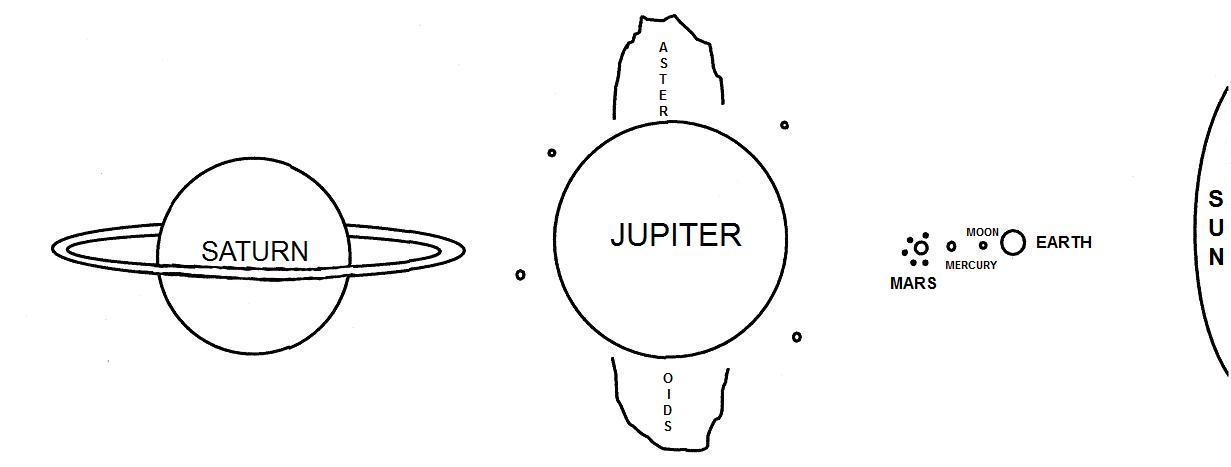
DELUGE CONFIGURATION
(Click on picture to enlarge)
Saturn ejected an enormous quantity of vaporized water, some of which is found today as ice on Mars and Moon. Jupiter protected Earth from total devastation, but there was widespread destruction and flooding. The water that entered our atmosphere rained down and raised sea level around the world. The water that remained in Saturn’s orbit formed rings of ice crystals. The nova destroyed Rhea and most of the debris from Rhea was drawn into Jupiter; what remained formed the asteroids and the miniscule satellites of Jupiter and Saturn. The debris that was drawn into Jupiter disrupted Jupiter’s equilibrium and formed a comet that was ejected two centuries later.
It is popular to say that everyone has a tradition of “the flood” but I would have no theory if I depended on ancient flood traditions. There was extensive flooding following the Doomsday cataclysm but there are very few references to that flooding (see Gen 1:2 for an obscure reference). The Doomsday flooding was caused by disruption of the Earth’s rotation and cataclysmic displacement of water. Most flood myths are a conflation of the fourteenth century BCE Deluge of Noah and the floods of Deucalion and Ogyges, which occurred during the Venus cycle of cataclysms in 982 and 930 BCE. The floods of Deucalion and Ogyges were also caused by displacement of water. In this study, the Sumerian, Hebrew, Hindu, Maya, Aztec and Hawaiian traditions describe a flood caused by a deluge. The other fourteen traditions have flood stories, but the cause of the flood is either unclear or was not a deluge. About half of the flood myths around the world describe a torrential rainfall.
Saturn’s nova caused the collapse of the Early Bronze Age. This common reference point should provide clarity in the face of otherwise unexplained flood evidence, e.g., a Bronze Age rise in sea level, or an archaeological level of mud. Since the flood was preceded by intense light, there were other forms of destruction as well.
Saturn’s nova caught Mars and Mercury as they curved around Jupiter in the direction of Earth; the force of the nova drove Mars and Mercury out of Jupiter’s orbit. Mars attracted several asteroid satellites; Mercury did not. The nova also caught Moon in the same position with respect to Earth and caused Moon to go into a higher orbit.
The survivors of the Deluge saw Mars and Mercury go round and round in a gravitational dance, creating a caduceus out of vapor, dust and plasma. In some cultures the caduceus was perceived as a monster. The strands of the caduceus were perceived as fetters for the monster, as were the rings of Saturn. In some cases, the trails were seen as a collaboration of two deities who were spouses or siblings, sometimes twins. When Mars and Mercury assumed stable Earth orbits the Caduceus dissipated, and Mars, Mercury or Moon might receive credit for defeating the Caduceus Monster. Many traditions have a fire god and a god who fell from heaven. This god can be Mars or Mercury but is usually Mercury. The god who fell from heaven was sometimes conflated with the Caduceus Monster. When Mercury and Mars separated, one of Mars’ asteroid satellites was drawn away and fell on Mercury, creating the image of Mars losing a part of his body. In some traditions, Mars’ asteroid satellites gave the impression of Mars being cut up into pieces. In other traditions Mars’ asteroid satellites were described as subordinates, warriors, horses, children, snakes or insects.
Rabbinical tradition says the sky was brighter than the brightest sunlight for seven days and nights prior to the Deluge. I do not believe the Deluge began immediately after the seventh day. The light was followed by heat, which caused a drought. The heat was followed by the caduceus dance of Mercury and Mars, and the close approach of both satellites to Earth. In some traditions Mercury or the Caduceus Monster was blamed for the drought. As Mars and Mercury moved around each other in search of equilibrium, Mars was given credit for ending the drought or defeating Mercury in some other version of the story. The vaporized water that entered Earth’s atmosphere formed massive clouds. When the water precipitated out and caused a memorable deluge, it gave rise to the imagery of waters “above the firmament,” which was conflated back into the Hebrew creation story. After the Deluge, Mercury was given credit for announcing the coming of the rain. Eventually Moon, Mercury and Mars lined up in orbit around Earth. Mercury was seen as moving swiftly across the sky, and it appeared to be the largest of the three satellites. Mars, actually the largest but furthest away, was sometime occluded by Moon.
10 – THE CADUCEUS, MARS AND MERCURY
Greek – The Aloadae were twin giants who imprisoned Ares (Mars) for a year and wound up in the Underworld bound by snakes. There is another myth about the Medusa (Mars), a woman with snakes coming out of her head. Medusa’s head was cut off and given to Athena (warrior Moon, later Venus) as an emblem for her shield. One can make out the profile of a woman’s head on the face of the Moon. Hermes (Mercury) was credited with assisting Perseus in slaying the Medusa. In Greek tradition Hermes was depicted with the caduceus.

PROFILE OF A WOMAN’S HEAD ON THE MOON
Roman – Roman tradition mirrored Greek tradition. The Aloadae imprisoned Mars for a year. Medusa’s head was given to Minerva (warrior Moon). Mercury was depicted with the caduceus.
Norse (Germanic) – Fenrir was a giant wolf the gods wanted to subdue. Tyr (Tiw, Mars) agreed to put his hand in Fenrir’s mouth while Fenrir was tied up. When Fenrir realized he had been tricked he bit Tyr’s hand off. This is a description of Mars losing a satellite while making the Caduceus Monster with Mercury. Fenrir didn’t resemble a caduceus but the story placed great emphasis on the strength of the fetters used to bind him. Fenrir ended up in fetters on a great stone slab (Saturn as a place of imprisonment).
Irish (Gaulish) – During the first battle of Mag Tuired, The Fir Bolg champion, Sreng (Caduceus Monster), cut off the right hand of the Tuatha De leader, Nuada (Mars). During the same battle, The Morrigan (love goddess Moon in Tuatha De Danann tradition) killed the Fir Bolg king, Eochaidh. Eochaidh comes from a word that means “horse,” and probably also indicates the Caduceus Monster. The Caduceus Monster dissipated when Mars and Mercury came in the vicinity of the Moon. Bres (Mercury in the Fomorian tradition) was known as Eochaidh Bres. Unfortunately for me, but not for the Fir Bolg, Sreng (Caduceus Monster) rallied his tribe after the death of their king (also Caduceus Monster). Because the mythmakers had elements of different stories and different names, they combined them in ways that are only possible in the convoluted logic of myth.
After the battle, Brigid (warrior Moon in Tuatha De Danann tradition) announced that Nuada was not fit to serve as king, and Bres was chosen to take his place. Nuada had his hand restored and he regained the leadership of the Tuatha De Danann. In the second battle of Mag Tuired, Nuada deposed Bres, which corresponds to other mythical traditions. The Gaulish cognate of Nuada was Nodens, who was identified with Mars in several Roman inscriptions.
Irish and Gaulish traditions are the most convoluted traditions I researched, largely because of the length of time these traditions were impacted by Christian reinterpretation. My interpretations are admittedly tenuous, but I believe the elements of my theory are present.
Egyptian – Wadjet was considered the Egyptian equivalent of the Medusa (Mars). She was depicted as a snake and was the source of the Uraeus (cobra) ornament. Wadjet was paired with Nekhbet (Mercury) as the “two ladies.” She was associated with the caduceus.
Sumerian – Ningishzida was a monster in the form of a caduceus. Enki (Mercury) was depicted with the caduceus.
Babylonian – Babylonian tradition mirrors Sumerian tradition. Ningishzida was a monster in the form of a caduceus. Nabu (Mercury) was depicted with the caduceus.
Hurrian/Hittite – Ullikummi (Caduceus Monster) was the younger brother of Hedammu (Doomsday monster). His father was Kumarbi (Saturn), who had been dethroned by Teshub/Tarhun (Jupiter). Kumarbi created Ullikummi to regain his throne. Astabis (Mars) led warriors (asteroid satellites) against Ullikummi but he was unsuccessful. Finally, Ea (Mercury) obtained the knife that was used to separate heaven and Earth (reminiscent of the sickle used by Kronos to castrate Uranus) and cut down Ullikummi. Ullikummi did not resemble a caduceus but the story has Mars and Mercury, who comprised the caduceus, in battle with Ullikummi. Teshub and Tasmisu (one of the Galilean moons) are also part of the story, but they did not engage Ullikummi in battle.
Canaanite – In the Canaanite Baal Cycle the Doomsday scenario and the Mercury-Mars scenario were conflated. The Doomsday monster, Yam, was also the Caduceus Monster. Baal Hadad (Jupiter) defeated Yam and asked El (Saturn) if he could build a palace (take over supremacy from him). Baal Hadad commissioned Kothar (Mercury) to build the palace. Mot (Mars) killed Baal Hadad by passing in front of him and partially obscuring him from view. Anat (war goddess Moon) cut Mot into pieces (the asteroid satellites whirling around Mars). Both Baal Hadad and Mot recovered and Mot submited to Baal Hadad (settled into stable orbit). In Canaanite tradition, Aziz was the demon equivalent of Hebrew Azazel.
Hebrew – Azazel was the name of the goat in the ritual of the scapegoat, but the tradition of Azazel goes back to a great worm or serpent. In the Book of Enoch, Azazel is the Caduceus Monster. Raphael (Mars) defeated Azazel and put him in chains. Cain and Abel are clearly Mars and Mercury but there is very little in the Bible to identify them as such. In myths depicting Mars and Mercury fighting, Mars usually defeats Mercury (cf. Irish, Persian and Hawaiian traditions). There is a large dark area on Mars that would qualify as “the mark of Cain.”
Arabian –Hubal (Mars) was depicted with his right hand broken off and replaced with a gold hand (cf. Norse Tyr). Azazil (Caduceus Monster) was conflated with the fallen angel (see section 14).
Persian – Azi Dahaka was a two-headed serpent or dragon created by Ahriman (Saturn’s nova produced the Caduceus Monster). Azi Dahaka had long necks that could not be cut off without another one growing back. Feyredon (Mars) and Kaveh (Mercury) battled Azi Dahaka, who was subdued by Fereydun and put into chains. In another myth the dance of Mars and Mercury was seen as a combat in which Apaosha (Mercury) was causing a drought. Tishtrya (Mars) defeated Apaosha, who threatened to bring on a flood.
Hindu – Vritra was a serpent who swallowed all the water on Earth and caused a drought. Vritra (Caduceus Monster) was defeated by Indra (Mars). Indra and Agni (Mercury) were twin brothers. In another myth, Durga (warrior Moon) defeated Mahishasura, a Medusa (Mars) like demon, who had many accomplices with weapons (the asteroid satellites of Mars). Durga appeared in a blinding light (Saturn’s nova) to combat Mahishasura.
Maya – Vucub Caquix was a bird demon pretending to be the Sun and the Moon. Vucub Caquix was defeated by the Hero Twins Hunahpu (Mars) and Xbalanque (Mercury). In the struggle Vucub Caquix severed an arm from Hunahpu. The story of Vucub Caquix and the Hero Twins takes place during the time of the “wooden people” who were destroyed by a flood caused by powerful rainstorms.
Aztec – Coatlicue (Rhea) had her head cut off and the blood spurting out of her neck formed two gigantic serpents. The instant she was killed, Huizilopochtli (Mars) sprang out of her womb. On an earlier occasion Coatlicue gave birth to Qutezalcoatl (Mercury, later Venus as morning star) and Xolotl (Venus as evening star, conflated back as a fire god twin of Quetzalcoatl).
Quetzalcoatl did service in Aztec tradition as the Doomsday monster, the Caduceus Monster (combined with Huizilopochtli) and the Venus monster.
The Earth monster, Tlatecuhtli (also known as Cipactli), battled Quetzalcoatl (Mercury) and Blue Tezcatlipoca (Huizilopochtli/Mars). During the battle Tlatecuhtli bit off Blue Tezcatlipoca’s right foot. This compares to stories in other traditions about Mars’ losing a part of his body.
In another Aztec myth the fire serpent, Xiuhcoatl, was considered the spirit form of the fire god, Xiuhtecuhtli (Mars) and a weapon of Huitzilopochtli (also Mars).
Inca – Pacha Kamaq (Caduceus Monster) supposedly created the first man and the first woman. He forgot to feed them, and the man died. The woman cursed Pacha Kamaq, who killed her son Mallko (Mars) and cut him into pieces (Mars’ satellites). Pacha Kamaq then killed the woman (Rhea was destroyed by the nova that produced the Caduceus Monster). The woman’s second son Wichama (Mercury) drove Pacha Kamaq into the ocean (The caduceus dissipated after Mars and mercury settled into stable orbits.)
In the myth Amaru Aranway, two serpents fight each other until they are subdued by two deities. Unfortunately for my theory, the deities are Illapa (Jupiter) and Wayra (Wind) not Mars and Mercury.
After the great flood, Viracocha (Saturn) saved two children of Inti (Sun, but in this case probably Jupiter) Manco Capac (Mercury) and Mama Ocllo (Mars). Brother and sister, husband and wife, these two restore civilization to the world.
Sioux – Unk (Rhea) did not like Ksa (Saturn) so she mated with her son Iya (Doomsday monster) and created Gnaski (Caduceus Monster). For her impertinence, Unk was expelled from the circle of divine entities (Rhea was destroyed by Saturn’s nova). Gnaski assumed the form of Ksapela (Mercury) and confounded Ksa until he became Iktomi (Saturn after the Deluge).
There is a Sioux myth about a mother of twins (Rhea) who died when she looked at a two-faced monster (Caduceus Monster), named Hestovatohkeo’o. Her sons (Mars and Mercury) grew up and became heroes.
Chinese – Fu Xi (Mercury) and Nuwa (Mars), brother and sister and husband and wife, were depicted as intertwined serpents (caduceus).
Lei Gong and Lei Zi were husband and wife and together they produced thunder and lightning. Lei Gong rode a chariot and had a driver and four assistants who also produced weather phenomena. These are representations of the asteroid satellites of Mars. Lei Gong (Mars) was assigned the role of thunder deity instead of Zhuanxu (Jupiter).
Japanese – Izanagi cut Kagutsuchi (Mars) into pieces with a special sword, Ama-no-ohabari, a manifestation of the Caduceus. Benzaiten (Mercury) was compared to Saraswati (Rhea in Hindu tradition; the comparison was not apt), who was associated with Indra (Mars) and the destruction of Vritra (Caduceus Monster). Benzaiten was associated with a five-headed dragon.
Okuninushi (Mars) wanted to marry the daughter of Susanoo (Jupiter). Susanoo compelled Okuninushi to sleep first in a room full of snakes and then in a room full of centipedes and wasps. These are suggestive of the asteroid satellites swirling around Mars.
Hawaiian – Tuna (an eel transformed into a man) told Hina (Rhea) that there would be a great downpour the next day. Tuna and Hina lived together until Hina left Tuna and took up with Maui (Warrior Moon). Maui destroyed Tuna by entering Tuna’s body and tearing it apart. This story is a conflation of the Deluge and the configuration of the Solar System after the Deluge. Tuna was the Caduceus Monster telling Hina, who no longer existed, that the Deluge was coming. After the Deluge, Hina was transformed into a composite lunar deity with Maui (who would later become Venus). Numerous traditions imply that the Caduceus Monster ceased to exist after encountering Moon. Tuna announcing the Deluge corresponds to other traditions in which Mercury announced the Deluge.
In another Hawaiian myth, Kamapua’a was a “hog-man” associated with Lono (love deity Moon). Kamapua’a (Caduceus Monster) attempted to rape Pele (Mercury). Pele’s sister Kapo (Mars), known as “red spotted,” distracted Kamapua’a by flinging her detachable vagina (asteroid satellite of Mars) past him as a lure. There are numerous traditions in which a part of Mars is detached, usually his arm or hand.
In yet another Hawaiian myth the fire goddess Pele (Mercury) was paired with the snow goddess Polia’ahu (Mars). The two fought each other in a cataclysm that caused earthquakes. Polia’ahu won the fight, which is consistent with traditions in which Mars defeats Mercury or the Caduceus Monster.
Moon was so close to Earth after the Doomsday event that it had a compelling sexual aspect. As we saw earlier (section 6), many of the names we associate with Venus began as names for the Moon, and often there were male counterparts. After the Deluge Moon was driven into a higher orbit and was seen as a changed deity. There was a perceived interaction between Mars and Moon, and Moon acquired a warlike persona. These warrior names also migrated to planet Venus, hence her dual identity. This study will show that the dual identity of planet Venus began as a dual identity of the Moon.
11 – LOVE GODDESS AND WARRIOR MOON
Greek – Aphrodite’s war goddess persona was Athena.
Roman – Venus’ war goddess persona was Minerva.
Norse – Freyja’s war god persona was Loki, but Freyja also had a war goddess aspect.
Irish (Gaulish) – The war goddess persona for The Morrigan was Brigid (Brigantia). The war god persona for Eriu was Lugh (Lugus).
Egyptian – Hathor became Sekhmet when she was enraged, and returned to Hathor when she calmed down.
Sumerian – Inanna, goddess of love and fertility, was also a war goddess but her name did not change.
Babylonian – Ishtar’s war goddess persona was Ereshkigal. Ereshkigal and Ishtar were considered sisters.
Hurrian/Hittie – Ishara, love goddess, was equated with Ishtar. Her other persona, Shaushka, was also identified with Ishtar but as a goddess of love and war.
Canaanite – Athtart’s war goddess persona was Anat.
Hebrew – Ashteroth’s war god persona was Samael.
Arabian – Al-Uzza was equated with Aphrodite. Her war goddess persona was Al-Lat, who was equated with Minerva, the Roman equivalent of Athena.
Persian – Anahita’s war god persona was Mithra.
Hindu – Shatarupa’s war goddess persona was Durga.
Maya – Goddess I, goddess of love and fertility. Her war goddess persona was Xquic.
Aztec – Xochiquetzal’s war goddess persona was Chalchiuhtlicue.
Inca – Inca tradition does not describe a war deity counterpart to Mama Killa.
Sioux – Woope was conflated with Wohpe, the White Buffalo Calf Woman, who was conflated with Anung Ite (warrior goddess Moon, see section 12).
Chinese – Guanyin’s war god persona was Zhu Rong.
Japanese – I think Inari was the original love deity Moon. Tsukuyomi killed Uke Mochi, a manifestation of Inari, and took over the identity of Moon.
Hawaiian – Lono’s war goddess/god persona was Hina/Maui (see section 12).
Mars and Mercury revolved around Earth seeking equilibrium. Their orbits were unstable and their conjunctions with each other and the Moon suggested different relationships. The sequence for an observer on Earth was Moon, Mercury, and Mars. Moon’s disc was large enough to occlude Mars, and there were times when Mars was obscured from sight. Rhea had disappeared and her identity was often conflated with Moon. Consequently, Moon/Rhea was seen as the consort or mother of Mars. There was also a conflation of these relationships with the drama surrounding the Caduceus Monster. Some of the Caduceus interactions detailed in section 10 reappear in the following section. The fact that later generations retold these stories but did not see the original phenomena makes my interpretation more art than science.
12 – MARS, MOON AND THE FAMILY OF THE GODS
Greek – Ares (Mars) had an affair with Aphrodite (love goddess Moon) and was trapped by Aphrodite’s husband, Hephaestus (god of fire, another manifestation of Mercury), in an invisible net. Mars was occluded by Moon which made Mars seem locked in thrall.
The dates for Homer and the Iliad are not settled, but it seems likely that Homer responded to the appearances of Mars in the seventh to fifth centuries BCE by weaving together elements of two older stories. In Homer’s time, Jupiter was no longer a disc in the sky. Mars was a pinpoint of light replaced by Venus, another pinpoint of light. There was no drama between Venus and Mars visible from Earth, but after Venus displaced Mars, Mars encountered Earth numerous times while seeking a stable orbit. In Homer’s epic poem, the Greeks defeated the Trojans and Athena, patron deity of Greece, defeated Ares, patron deity of Rome. The Trojan War is believed to have taken place in the seventh century BCE (revised chronology). The battles between Mars and Moon took place in the thirteenth to twelfth century BCE. In the Iliad, Zeus (Jupiter) tells Aphrodite (Moon) to stay out of the conflict. Homer believed Aphrodite and Athena were different spheres in the sky. In the thirteenth to twelfth century BCE Aphrodite and Athena were different personas for the same sphere.
Roman – Mars had an affair with Venus (love goddess Moon) and was trapped by Venus’ husband, Vulcan.
Norse (Germanic) – Fenrir (Caduceus Monster) was the son of Loki (warrior Moon). Loki heckled Freyja (love goddess Moon) about being the lover of all the Gods, including her twin brother (and alter-ego) Freyr. Loki heckled Tyr (Mars) about being a cuckold, but Tyr’s wife was not specified. Loki had a role in Norse mythology somewhat similar to the role of Ahriman in Persian mythology. Loki was responsible for most of the dastardly deeds in Norse tales. As warrior Moon and Venus, he was the “father” of both the Caduceus Monster and the Venus Monster. In the convoluted logic of mythology, the character of Loki heckled Freyja about her brother Freyr while in reality Loki, Freyja and Freyr were all the same sphere.
Irish (Gaulish) – During the first battle of Mag Tuired, the Morrigan (love goddess Moon in Tuatha De Danann tradition) killed the Fir Bolg king, Eochaidh (Caduceus Monster). After the battle, Brigid (warrior Moon) announced that Nuada (Mars) was not fit to serve as king (see section 10).
Egyptian – Wadjet (Mars as Medusa) was associated with Hathor (love goddess Moon) and Sekhmet (warrior Moon). Hathor was the mother of Anubis (also Mars).
Sumerian – Inanna (love and war goddess Moon) went to the Underworld to attend Nerigal’s (Mars) funeral. Numerous myths with the theme of Mars’ death or disappearance tell us that Mars was not visible for a while. In some myths Inanna was Nerigal’s mother.
Babylonian – Erishkigal (warrior Moon) banished Nergal (Mars) and later married him.
Hurrian/Hittite – Rising up in defense of Teshub, Ishtar (Ishara, love goddess Moon) tried unsuccessfully to charm Ullikummi (Caduceus Monster). Astabis (Mars) led warriors against Ullikummi but he also was unsuccessful. Astabis’ Hittite name was Zababa, whose consort was Ishtar (Ishara).
Canaanite – In the Canaanite Baal Cycle Anat (war goddess Moon) cut Mot (Mars) into pieces.
Hebrew – Some Rabbinical sources identify Samael (warrior Moon) as a seducer of Eve (Rhea), making her pregnant with Cain (Mars).
Arabian – Al-Lat (warrior goddess Moon) was the mother of Hubal (Mars). Al-Lat was part of a pre-Islamic triad of moon goddesses, along with Al-Uzza (love goddess Moon) and Manat (crescent moon). Hubal was married to Manat and associated with Al-Uzza as a protector. The triad of Al-Lat, Al-Uzza and Manat illustrates the vexing identity problem: Moon had three names, two of which were transferred to Venus (first Al-Lat, later Al-Uzza).
Persian – Tishtrya (Mars) and Mithra (warrior Moon) were associated with each other as colleagues, which is reminiscent of the romance of Ares and Aphrodite.
Hindu – Durga (warrior Moon) defeated Mahishasura, a Medusa (Mars) like demon, who had many accomplices with weapons (the asteroid satellites of Mars). Durga is pictured as a goddess with many more arms than is typical in Hindu deities. Durga was given the arms to fight the asteroid satellites of Mars.
Maya – Xquic (warrior Moon) was the mother of Hunahpu (Mars) and Xbalanque (Mercury), the Hero Twins who defeated Vucub Caquix (Caduceus Monster).
Aztec – Xiuhtecuhtli (fire god manifestation of Mars) was married to Chalchiuhtlicue (war goddess Moon).
Inca – Mama Killa (Moon goddess) was the mother of Manco Capac (Mercury) and Mama Ocllo (Mars).
Sioux – Ite (war goddess Moon), like Woope (love goddess Moon), was the daughter of Skan (Sky) [In some stories Ite was the daughter of Old Man, Waziya, and Old Woman, Wakanaka]. Her name means “face.” Ite was courted by Ksapela (Mercury) and Tate (Mars). She eventually chose to marry Tate but maintained contact with Ksapela, who enticed Ite to take the place of the Moon. For her punishment, one of Ite’s faces was made ugly and she became known as Anung Ite (double faced). There is plenty of support in other traditions for Moon being “two-faced” (having two identities), but no other tradition describes Moon as being disfigured. One can imagine the face of a woman in profile on the moon (see section 10).
Chinese – Gong Gong (Caduceus Monster) was the offspring of Zhu Rong (warrior Moon). Unfortunately for my theory, Gong Gong was a conflation of the Venus monster and the Caduceus Monster (see section 16). Zhu Rong and Gong Gong engaged in battle and Gong Gong lost the battle. Gong Gong lashed out and damaged the world, which Nuwa (Mars) repaired. On a subsequent occasion Nuwa behaved like a warlike deity while Fu Xi went his separate way and behaved like Mercury (see section 14).
Japanese – Inari (love goddess Moon) was sometimes conflated with Benzaiten (Mercury). There are no Japanese myths linking Moon and Mars deities.
Hawaiian – Tuna (Caduceus Monster) and Hina (Rhea reconfigured as Moon) lived together until Hina left Tuna and took up with Maui (Warrior Moon). Hina was transformed into a composite lunar deity with Maui (who will later become Venus).
When Saturn exploded and caused the Deluge, the explosion also destroyed Rhea. In many traditions, Saturn was given a new identity and Rhea dropped out of the drama. Saturn disappeared from the sky on a seasonal basis and became known as a god of vegetation and rebirth. Saturn and Moon appeared in conjunction, which prompted stories about their relationship, usually connected with death or resurrection. In the Egyptian tradition Saturn’s wife went looking for Saturn. In most traditions Saturn went to the Underworld, not to find his wife from the Golden Age but to find the love goddess Moon he created at the end of the Golden Age. There was conflation of Rhea and love goddess Moon because Rhea ceased to exist and love goddess Moon became a war goddess after her interaction with Mars. In the convoluted complexity of mythology, Moon’s old and new names were conflated. In some traditions the ancients construed Saturn as a place of imprisonment and the rings of Saturn were seen as fetters.
13 – SATURN, RHEA AND MOON AFTER THE DELUGE
Greek – Adonis (Saturn) died in Aphrodite’s arms. Saturn’s rings were fetters for Prometheus (see section 14) and the Aloadae (see section 10).
Roman – Adonis died in Venus’ arms. Roman tradition mirrored Greek tradition about Prometheus and the Aloadae.
Norse – Odin (Saturn) hanged himself on Yggdrasil (tree of life) and was resurrected as a configuration of Mercury, hence the name Wednesday, which is Mercury’s day in other traditions. Freyja (love goddess Moon) was described as weeping for her husband Od, who was probably Odin since little is known about Od. Odin and Loki (warrior Moon) were blood brothers, which suggests a relationship that fits the paradigm of Saturn and his mate. Saturn’s rings were fetters for Fenrir (Caduceus Monster). Loki was also bound in fetters, which is probably a conflation of Loki and Fenrir, Loki’s son.
Irish – During the second battle of Mag Tuired, which depicts the Thunderbolt, Elatha was a bystander, reflecting his diminished role in the cosmic drama.
Egyptian – Seth (bad Jupiter) cut Osiris (Saturn) into pieces. Isis (Rhea) put the pieces together (with the help of Horus (good Jupiter), since Isis didn’t exist anymore) and wrapped Osiris in bandages. Isis represents one of three instances of Rhea having an identity and a role after her destruction (see Hurrian/Hittite and Japanese traditions).
Sumerian – Dumuzi (rebirth and vegetation deity) went to the Underworld to find Inanna.
Babylonian – Tammuz (variant of Dumuzi) went to the Underworld to find Ishtar.
Hurrian/Hittite – Telepinu was a god of farming, whose disappearance caused animal and plant fertility to fail. Hannahannah (Rhea) sent a bee to find him. The bee flew around Telepinu (a stylization of the rings of Saturn) and stung him. This parallels the Egyptian paradigm of Osiris and Isis rather than the Sumerian paradigm of Dumuzi and Inanna. Telepinu woke up from the bee stings and wreaked destruction on the world. Telepinu’s anger was then magically sent to the Underworld. This is a conflation of the elements of the Deluge and Saturn’s identity following the Deluge.
Canaanite – Canaanite tradition anticipates Hebrew tradition. Adonai was Saturn reborn, but no mate is mentioned.
Hebrew – Adonai started out as a reborn god as in the Canaanite tradition. Eventually the term was used for YHWH when it was forbidden to speak the name of God. There is also a rabbinical tradition of Khima (Saturn) in bondage. Hebrew tradition ignored Rhea as a mate and numbered her as an archangel.
Arabian – Tammuz was borrowed from Babylonian tradition. Arabian tradition started after the Deluge so there is no mate.
Persian – Ahriman was Saturn before and after the Deluge. Persian tradition invested most of its evil in Ahriman, who was also the Doomsday and Venus monsters. Ahriman was linked to some horrible female deities.
Hindu – I believe Brahman and Devi started their lives as Saturn and Rhea in the Golden Age. After the Doomsday event Brahman and Devi were theologized into ineffable essences of divinity. Brahman was transformed into Brahma, a tangible god, and joined to Saraswati (Rhea), who was then conflated with Shatarupa (love goddess Moon).
Maya – Hun Hunahpu (Saturn after Doomsday) was the father of the Maya Hero Twins, Hunahpu (Mars) and Xbalanque (Mercury), who avenged their father’s death. The Twins’ mother was Xquic (warrior Moon), who became pregnant from Hun Hunaphu’s decapitated head in the Underworld.
Aztec – Xipe Totec (Red Tezcatlipoca, Saturn after Doomsday) was an important god of vegetation and rebirth. The worship of Xipe Totec required the priests to flay the skins of human sacrifices and put them on. This gruesome celebration emulated the rings of Saturn. Xipe Totec was not associated with a female deity. He was the patron deity of goldsmiths, calling to mind the yellow color of Saturn.
Inca – Viracocha (Saturn) destroyed his first creation with a flood and then disappeared from the cosmos. Mama Qucha (Rhea), however, did not disappear. She was translated into a sea goddess, probably because she was associated with the flood.
Sioux – Iktomi (Saturn after Doomsday) was a central player in Sioux creation stories. He was known as “spider,” a stylization of Saturn’s rings. Iktomi was originally known as Ksa (Saturn before Doomsday) but he was stripped of that title (see section 10).
Chinese – Miaozhuangyan was the father of Miaoshan, an incarnation of Guanyin (love goddess Moon), who sacrificed her eye and her arm to save him. Miaozhuangyan was a powerful ruler who was humbled by illness (jaundice, the color of Saturn) and the sacrifice of his daughter (a conflation of Rhea and love goddess Moon).
Japanese – In Japanese mythology the creation of Sun, Moon and Jupiter occurred after the birth of Kagutsuchi (Mars) and events that resemble the Caduceus. Izanami (Rhea) died after giving birth to the fiery god and Izanagi went to the Underworld to find her.
Hawaiian – Kanaloa and Kane (Jupiter) were coupled as complementary powers. The four highest gods in the Hawaiian pantheon were Ku (Saturn before Doomsday), Kane, Lono (love deity Moon) and Kanaloa (Saturn after Doomsday). Kanaloa was associated with spirits “spit out by the gods” (Mercury and Mars thrown out of orbit after Saturn’s nova), and he was symbolized by an octopus (a stylization of the rings of Saturn). There is no mention of a mate for Kanaloa.
There is a second genealogy in Genesis, between Arphaxad and Terah, with a time frame different from the genealogy between Adam and Noah. In this genealogy the average Biblical age of becoming a father was 36 and the average Biblical age of death was 300 (Since Noah and Shem overlap the periods before and after the Deluge, I did not include them in my averages). If we once again suppose that Nahor (Biblical father at 29) became a biological father at 12 (4,380 days), the average age of fatherhood was 15 and the average age of death was 124. In today’s reckoning, Nahor became a father after twenty-nine 151-day ‘years’ (4,379 days). Moon was farther away from Earth at this time and so was Jupiter. However, Mercury and Mars were orbiting Earth, and I believe the 151-day period was a combination of the lunar and Mercury cycles.
After Mercury and Mars settled into orbit around Earth, Mercury acquired an identity distinct from Mars. Mercury’s disc was larger than Moon or Mars and it rivaled the disc of Jupiter, giving the impression that Mercury was the new dominant god. In many traditions Mercury got a new name. Mercury revolved around Earth faster than Moon and Mars, so there were fewer relationships between Mercury and other deities. Mercury was seen as having announced the Deluge. Mercury was also seen as having stolen light or fire from the gods. Mercury was often seen as creative and benevolent while Mars was seen as destructive and evil. The Caduceus was assigned to Mercury as a staff of authority (it was later assigned to other deities).
Two hundred years after the Deluge, Jupiter became unstable and ejected the material it had absorbed after Saturn’s nova. Jupiter became the father of Athena (Venus). In the process of ejecting Venus, Jupiter created an enormous electrical storm that impacted the Earth. The cataclysm is known as the Thunderbolt, and it is familiar to us as the destruction of Sodom and Gomorrah. In Babylon it was known as the destruction of the Tower of Babel.
Jupiter’s electrical storm and ejection of Venus caught Mercury and Mars rounding Earth toward the Sun, just as they had been caught during Saturn’s nova, and they were driven out of orbit from Earth. Mercury went into its present orbit and Mars went into the orbit currently occupied by Venus. Jupiter’s electrical storm caused a widespread “confusion of tongues” or aphasia, which was associated with Mercury. As a consequence of the “confusion of tongues” Mercury was associated with written language, knowledge and creativeness.
The Thunderbolt cataclysm caused the collapse of the Middle Bronze Age. There are numerous archaeological sites that show Tunguska-like destruction, and this cataclysm provides a way of linking these archaeological sites to a common point in time. Unfortunately, the collapse of the Late Bronze Age, caused by two successive Venus cataclysms, will show similar damage. However, the Thunderbolt cataclysm will show damage mostly caused by electromagnetic energy from above. The Venus cataclysms will show similar damage but also damage caused by lateral movement and the gravitational effects of a large body.
This was the configuration of the Solar System following the Thunderbolt:
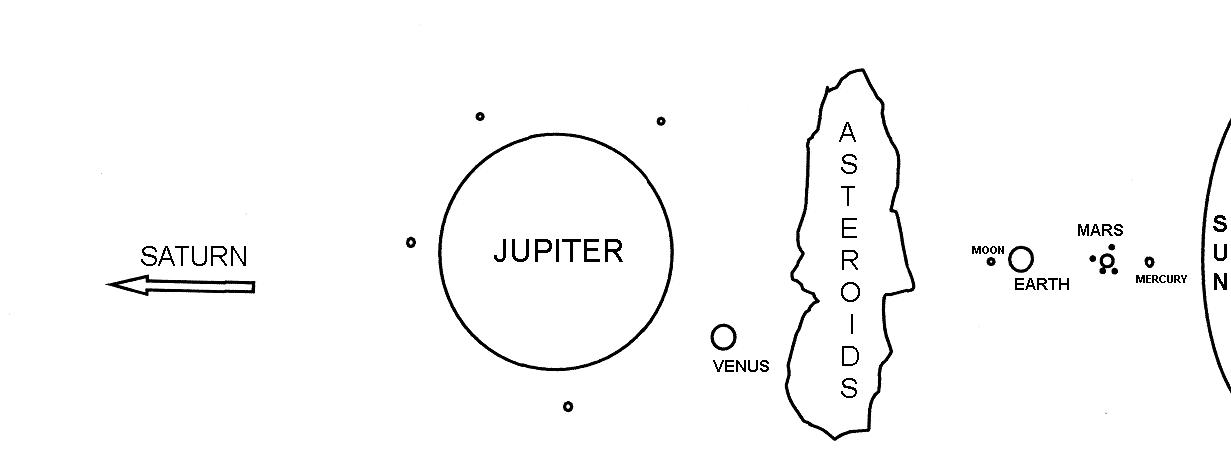
THUNDERBOLT CONFIGURATION
14 – MERCURY
Greek – Prometheus (Hermes, Mercury) stole fire from the gods and announced the flood. Prometheus wound up in fetters on a mountain. Prometheus was known as a trickster which was also Hermes’ reputation. There is an ancient myth that Hermes confused the languages.
The story of Phaeton is a conflation of story elements from the Deluge and the Thunderbolt. Phaeton (Mercury) brought heat to the Earth. His father was a conflation of Kronos (Saturn) and Helios (Sun). Zeus (Jupiter) destroyed Phaeton with a thunderbolt, which was the end of Mercury’s orbit around Earth.
Roman – The Romans mirrored the myth of Prometheus. Several traditions used the Latin name ‘Lucifer’ (light bearer) for their fallen deity. Lucifer was Mercury.
Norse – Baldr (Mercury) was the fallen deity. He was killed by an arrow (lightning bolt) from his brother Hodr, one of the Galilean moons of Jupiter. Loki was the instigator of the death of Baldr, and I think this is an instance of Venus making an early appearance in the mythology.
Odin (originally Saturn), reconfigured as Mercury, was associated with the invention of Runes.
Irish (Gaulish) – Ogma (Ogmios) was the name of Mercury in the Tuatha De tradition. Ogma was an important deity associated with the invention of the Ogham script. Ogma’s Gaulish counterpart, Ogmios, was represented with chains coming from his lips so that he could bind men to him, suggesting a facility for language.
Egyptian – Some researchers equate Prometheus with Thoth (Mercury). Thoth was held to be the inventor of writing and the creator of languages. There is a hymn to Thoth crediting him with confusing the languages.
Sumerian – Enki (Mercury) announced the flood and Enki was known as the confuser of languages.
Babylonian – Babylonian mythology followed Sumerian mythology. Nabu was identified with Enki (Mercury). Nabu means ‘one who announces.’ The story of the Tower of Babel (Gen 11:1-9) was incorporated into Hebrew tradition during the Babylonian captivity. It is a reasonable speculation that Enki/Nabu was the confuser of languages in the original story (see Hebrew tradition).
Hurrian/Hittite – The Hurrian/Hittite god of wisdom Ea/A’as was equated with Sumerian Enki.
Canaanite – Shaher was the Canaanite equivalent of Lucifer (Mercury). Kothar (Mercury) from the Baal Cycle was an inventor who created sacred words.
Hebrew – Uriel (Mercury) announced the flood to Noah in the Book of Enoch. Uriel means “God is my light.” Hebrew tradition also names Heylel (Hyle) as a fallen deity identical to Lucifer (Mercury).
In Gen 19:1 two angels (Mars and Mercury) met Lot in Sodom and announced the forthcoming destruction of the Cities of the Plain (see section 15).
When the Hebrews incorporated the Tower of Babel (Gen 11:1-9) into their tradition they changed the agent of confusion from Nabu (Mercury) to Yahweh (Jupiter). This was both politically and astronomically correct.
Arabian – Arabian tradition conflated Azazil (Caduceus Monster) with Iblis (Mercury) as a deity cast out of heaven. Arabian Nabu (Mercury) was borrowed from Babylonian tradition.
Persian – Apaosha (Mercury) was defeated by Tishtrya (Mars) and the drought caused by Apaosha ended. Apaosha then threatened to send too much rain. The original Mercury in the Persian tradition was Apam Napat, who was a fire god that originated in water. Apam Napat was equated with Agni (Mercury in the Hindu tradition).
Hindu – Agni (Mercury) means god of fire. He was also a messenger.
Maya – The Hero Twins, Xbalanque (Mercury) and Hunaphu (Mars) had two half brothers. During an argument the Hero Twins turned their half brothers into the Howler Monkey Gods, who were the patrons of artists and scribes.
Aztec – Quetzalcoatl (Mercury) was the patron of learning and the inventor of books.
Inca – After the Deluge, Manco Capac (Mercury) and Mama Ocllo (Mars) were charged with bringing civilization back to the world. Manco Copac is the god of fire, which is Mercury in other traditions. Manco Copac also has greater standing that Mama Ocllo, which is similar to other traditions in which Mercury briefly beame one of the supreme deities.
Sioux – Ksapela (Mercury) was a trickser. He was one of the forms assumed by Gnaski (Caduceus Monster). Ksa’s (Saturn’s) name means wisdom; Ksapela means “little wisdom.” Coyote (also Mercury) has been compared to Greek Prometheus as a stealer of fire. Coyote was a trickster accomplice of Iktomi (Saturn after the Deluge), as was Ksapela. Sioux tradition about Iktomi somewhat resembles Norse tradition where Odin (Saturn) took on Mercury’s identity.
Chinese – Sui-Jen (fire man) was considered the Chinese Prometheus who brought fire down from heaven. Fu Xi (Mercury) was the inventor of writing.
Japanese – Benzaiten (Mercury) was the goddess of words, speech and eloquence.
Hawaiian – Pele (Mercury) is famous as the goddess of Hawaiian volcanoes. She was also a more conventional fire goddess. Pele was associated with a flood in the land of Kanaloa (Saturn after the Deluge)
Thunder and lightning from the electrical storm were usually associated with Jupiter, but occasionally they were associated with Mars.
15 – JUPITER AND THE THUNDERBOLT
Greek – Zeus was known as the god of the thunderbolt.
Roman – Jupiter was known as the god of the thunderbolt.
Norse – Thor, with his hammer Mjolnir, was known as the god of the thunderbolt.
Irish – The Dagda (Jupiter) was pictured with a magic club reminiscent of Thor’s magic hammer. He was associated with showers of fire.
Egyptian – Horus was the gentle manifestation of Jupiter and Seth was known as the god of storms and chaos.
Sumerian – Ninurta was the god of thunder.
Babylonian –Ninurta and Marduk were both thunder gods.
Hurrian/Hittite – Teshub was depicted holding a triple thunderbolt and he was known as a storm god.
Canaanite – Ba’al Hadad was depicted with a thunderbolt and was equated with Zeus.
Hebrew –Yahweh was known to speak out of thunder (cf. Job 37:2-5, Ps 29:3). In the Bible narrative of Sodom and Gomorrah, Gen 19:24-28 describes a rain of burning sulfur that destroyed the cities of the plain. The sulfur is believed to have been created by lightning far more intense than what we experience. Normal lightning will produce a smell of sulfur.
Arabian –In Qur’an 13:13 Allah sends thunderbolts to strike those who dispute him.
Persian – Persian tradition invested all its evil in Ahriman, and all its benevolence in Ahura Mazda. Verethragna (Mars) was associated with Indra (Mars in the Hindu tradition), who was a god of thunder. Several traditions assign thunder and lightning to Mars rather than Jupiter
Hindu – Shiva was known as a god of thunder.
Maya – Huracan was a lightning deity.
Aztec – The Aztec tradition of “five suns” appears to describe a sequence of four cataclysms through Doomsday, Deluge, Thunderbolt, and a composite of the Exodus and Jericho cataclysms caused by Venus (see Worlds in Collision). The third cataclysm under the rule of Tlaloc was a rain of fire. By that point, Tezcatlipoca had assumed the identity of Tlaloc, who was known as a god of lightning.
Inca – Illapa was a god of thunder and lightning.
Sioux – Wakinyan means “thunder.” Wakinyan was a thunder god who morphed into the Thunderbird.
Chinese – Chinese tradition assigned thunder and lightning to one of their Mars deities, Lei Gong, rather than Zhuanxu.
Japanese – Susanoo was the god of storms.
Hawaiian – Kane was known as a god of thunder and lightning.
Venus was sometimes associated with the demise of Mercury or Mars. Even though Mercury fell out of the drama, he had loomed so large that he was often conflated back into creation myths as an equal to Saturn and Jupiter. Mars was not ranked as high as Mercury until the seventh century BCE, when Venus knocked Mars out of its orbit.
After the Thunderbolt cataclysm Moon went into a higher orbit around Earth and presented a smaller disc. It lost more of its tidal attraction and the ancients once again saw it as a changed deity. The warrior and love goddess names of Moon were transferred to Venus.
Saturn receded after the Thunderbolt cataclysm and does not appear in the later mythology. Saturn’s large satellite, Titan, was ejected when Saturn was out of sight from Earth. The fact that Titan still has an atmosphere suggests a recent ejection. Jupiter also receded through the asteroid belt and was less prominent. Venus was launched into the Solar System, and, in 982 and 930 BCE, it produced the cataclysms described by Immanuel Velikovsky in Worlds in Collision. In most traditions, Venus was known by the name of the warrior Moon, but in some traditions, Venus was seen as a new deity. Venus’ comet tail was seen in some traditions as the reappearance of an old adversary, and in some traditions, it was seen as a new monster. In several traditions it was conflated with the Doomsday monster or the Caduceus Monster. Jupiter, which had receded away from the Earth by 982 BCE, was usually given credit for fighting the Venus monster, even though Jupiter had no part in the conflict. Jupiter had been worshipped for many years as the primary deity, but by the time of the Venus cataclysms Jupiter was just a small disc in the sky. Many traditions saw Venus as a resurgence of Jupiter’s prominence.
16 – JUPITER, VENUS AND THE VENUS MONSTER
Greek – Athena was born from Zeus’ head. The Venus monster was known as Typhon, who battled Zeus.
Roman – Minerva was born from Jupiter’s head. Typhon battled Jupiter.
Norse – Loki (Venus) was not the child of Thor. Jormungandr (Venus monster) was the offspring of Loki, and in the saga Ragnarok, Thor battled Jormungandr. Thor killed Jormungandr but died shortly afterwards. This suggests that Jupiter faded from view after the Venus cataclysm.
Irish (Gaulish) – Brigid (Tuatha De warrior goddess Moon and comet Venus) was the daughter of The Dagda. Brigid’s Gaulish counterpart was Brigantia; both goddesses were equated with Minerva. Brigid’s name means “fiery arrow.”
Lugh (Lugus) was the Fomorian warrior Moon and comet Venus. He joined the Tuatha De Danann (he was ejected from Jupiter) during the second battle of Mag Tuired, which conflated elements of the story of the Thunderbolt and the Venus cataclysms. Lugh was the grandson of Balor (Jupiter in the Fomorian tradition). During the battle Balor killed Nuada (Mars in the Tuatha De Danann tradition). Mars was driven into a lower orbit during the Thunderbolt. Lugh, in turn, killed Balor (see Norse tradition). Balor was known for his “evil eye,” a reference to the great Red Spot, which is a disturbance in the gaseous outer layer of Jupiter caused by the ejection of Venus (Lugh). Lugh had a dog named Failinis and a horse named Enbarr (the name refers to the horse’s mane). Both creatures can be interpreted as manifestations of Venus’ comet tail. Lugh was known by the epithet “long arm.” Gaulish ‘Lugus’ invites comparison with Norse ‘Loki,’ both warrior Moon/Venus deities.
There is an Irish myth about a monster named Caoranach whose blood turned Lough Derg (Red Lake) red. This is one of the distinguishing characteristics of the Exodus cataclysm (cf. Exodus 7:17-20)
Egyptian – Sekhmet (Venus) was the child of Ra (Sun) not Horus or Seth. During the Venus cataclysm Seth transformed into Apep, the monster from the Doomsday cataclysm, and battled Horus. Ra sent Sekhmet on a rampage that nearly destroyed the Earth.
Sumerian – Inanna (Venus) was not known as the offspring of Ninurta (Jupiter). However, Inanna was equated with Ishtar (see Babylonian tradition). Imdugud, also known as Anzu, was a giant firebird defeated by Ninurta.
Babylonian – Marduk was a later Babylonian deity conflated backwards as a manifestation of Jupiter. He was originally Venus battling his own comet tail in the form of the monster Sirrush. Ninurta was the original manifestation of Jupiter from the Sumerian tradition. Ishtar (peaceful Venus) was the daughter of Ninurta.
Hurrian/Hittite – Inara (Venus) was the daughter of Teshub/Tarhunt (Jupiter). When Teshub battled the monster Illuyanka, Inara used a strategy with food and drink to help her father defeat the monster.
Canaanite – Anat (Venus) was the sister of Ba’al Hadad (Jupiter). The Venus monster was Lotan who fought Ba’al Hadad.
Hebrew – Michael (Venus) was an archangel of Yahweh (Jupiter). Michael delivered the Hebrew people from the Venus monster, Leviathan (also known as Rahab). Venus was conflated with Jupiter as Baal (from Canaanite Ba’al Hadad).
Arabian – Al-Lat was equated with Minerva and depicted as a warrior goddess. Arabian tradition conflated Azazil (Caduceus Monster) with the fallen deity (Iblis/Mercury). However, there is no clear tradition of a Caduceus Monster or a Venus monster. Islamic piety purged almost all of the pre-Islamic mythology that would support my theory.
Persian – Mithra was known as Mica (cf. Hebrew Michael, Venus) and he was the son of Ahura Mazda (Jupiter). Persian tradition invested all its evil in Ahriman, who Mithra fought on behalf of Ahura Mazda. Mithra was depicted as a giant serpent, which suggests that Mithra vanquished the Venus monster and incorporated its power.
Hindu – Shiva (Jupiter) was the father of Chathan, who transformed into Vishnu Maya (Vishnu by magic). Vishnu was a manifestation of Venus. Vishnu (in the form of Krishna) battled the serpent, Kaliya.
Kali (Venus) was the fierce aspect of Durga (warrior Moon). She was also the consort of Shiva. Transferring the violence of the Venus cataclysm to Kali and Shiva allowed Hindu tradition to perceive Vishnu (Venus) as a peaceful counterpart (preserver) to Shiva (creator/destroyer). In many traditions Venus’ rampage was forgotten and she acquired the love goddess identity.
Maya – The Maya tradition is suggestive but not definitive. The Maya name for Venus was Xux Ek (wasp star), but there is no familial connection. However, in the Popul Vuh, Kukulkan (both Doomsday and Venus monster) and Huracan (Jupiter) are linked together as “Maker and Modeler.” Huracan was a lightning deity with one serpent leg, suggesting victory over the Venus monster.
Aztec – The Aztec tradition of “five suns” appears to describe a sequence of four cataclysms through Doomsday, Deluge, Thunderbolt, and a composite of the Exodus and Jericho cataclysms caused by Venus (see Worlds in Collision). Unfortunately for my theory, the first two cataclysms don’t help me. However, the third cataclysm under the rule of Tlaloc was a rain of fire (Thunderbolt cataclysm). The fourth sun was under the rule of Chalchiuhtlicue (war goddess Moon, later Venus), who was Tlaloc’s wife or sister. This period ended with a 52-year long flood (not caused by a downpour), which corresponds to the interval between the Exodus and Jericho cataclysms. According to Velikovsky, the Exodus cataclysm was at the time of the flood of Deucalion, and the Jericho cataclysm was at the time of the flood of Ogyges, both floods caused by the displacement of water.
Tlahuizcalpantecuhtli was another Aztec name for Venus. He was considered a dangerous and malevolent god, associated with Quetzalcoatl (Venus monster). Quetzalcoatl (either Venus or Venus monster) was the son of Mixcoatl (one of two Jupiter deities, see section 8).
Quetzalcoatl did service in Aztec mythology as all three cataclysm monsters. Quetzalcoatl was also the planet Mercury (before Mercury dropped out of the drama) and the planet Venus as morning star, after Venus settled into orbit. Quetzalcoatl’s twin brother, Xolotl, was Venus as evening star.
The priest of Tlaloc (Jupiter) was addressed as Quetzalcoatl.
Inca – Ch’aska was the Inca name for Venus. Ch’aska was also a fertility goddess and the guardian of maidens, which gave her a connection to the original Moon fertility goddess (Mama Killa). Yakumama (Venus monster) was a destructive water serpent, associated with Illapa (Jupiter).
Sioux – Unktehila, the Horned Serpent, wreaked havoc on the Earth. Unktehila was destroyed by Wakiya or Wakinyan, the Thunderbird. Wakinyan had one eye (Jupiter’s red spot).
White Buffalo Calf Woman was known as Wohpe, which means meteor or falling star. Wohpe was supposedly the daughter of Wi (Sun) and Hanwi (Moon). Wohpe was conflated with Woope (love goddess Moon) and Anung Ite (war goddess Moon). When two hunters encountered Wohpe, one of the hunters was sexually aroused and made an advance on her. Wohpe turned the hunter into a pile of charred bones, demonstrating the destructive power of the Venus comet. Wohpe then told the other hunter that she meant peace and would prove it by giving the elders a peace pipe (Chanupa). This is a stylized representation of the Venus comet tail.
Chinese – Zhu Rong (Venus) was the son of Zhuanxu (Jupiter). Zhu Rong fought Gong Gong (Venus monster). Unfortunately for my theory, Chinese tradition conflated the Venus monster and the Caduceus Monster. The battle between Zhu Rong and Gong Gong changed the axis and rotation of the Earth, which happened during the Venus cataclysm. Gong Gong had a lesser associate, Xiangliu, a serpent with nine heads. Referring back to section 10, Xiangliu would be a perfect candidate for the Caduceus Monster, but the story of Nuwa (Mars) and Fu Xi (Mercury) does not mention Xiangliu.
Japanese – Susanoo (Jupiter) was asked to slay the dragon Yamata no Orochi (Venus monster), who had visited a family and devoured seven of their daughters (perhaps a reference to the number of times Venus had cycled). Susanoo slayed the dragon and cut it up, which caused the river Hi to flow with blood (cf. Exodus 7: 17-20).
During a cataclysm supposedly caused by Susanoo, Amaterasu (Sun) hid in a cave and would not come out until Uzume (Venus) tricked her into coming out. This corresponds to the Biblical story of the Sun being prevented from setting (Joshua 10: 12-13) and the Hawaiian myth about Maui lassoing the Sun at sunrise. At their longitude, the Japanese would have experienced an extended period of night.
Hawaiian – Maui (Venus) was a Kapua, a trickster and a monster. Consequently, Maui was both Venus and the Venus monster. He was not the son of Kane/Haumea. Maui was credited with raising the Hawaiian Islands up out of the sea, suggesting some cataclysmic event. His most famous exploit was lassoing the Sun as it attempted to rise. Compare this to Joshua 10:12-13 where the sun was prevented from setting. During the late spring and summer months it would be sunrise in Hawaii when it was sunset in the land of Canaan. Kane (Jupiter) did not interact with Maui.
Velikovsky analyzed Jubilee celebrations around the world and concluded the Venus cataclysms were separated by fifty-two years; the Bible suggests a much longer time of fifty-two-year encounters. I used Bible research and the work of Charles Ginenthal to come up with my dates.
Not long after the destruction of Sodom and Gomorrah, around 1138 BCE, Abraham perceived the angel of the Lord telling him not to sacrifice his son Isaac (Gen 22:11-16)
Fifty-two years later, around 1086 BCE, Jacob wrestled with God (Gen 32:1-2; 24-30).
Fifty-two years later, around 1034 BCE, Jacob, now an old man, had a vision of God telling him to join his son Joseph in Egypt (Gen 46:2-3).
Fifty-two years later, around 982 BCE, the Hebrews were delivered from bondage during the cataclysm of the Exodus (see Worlds in Collision). The length of time the Hebrews spent as slaves in Egypt is disputed and undergoing revision.
Fifty-two years later, around 930 BCE, Joshua led the Hebrew people in the conquest of Canaan. The Jordan River parted (Josh 3:15-16), Jericho was destroyed (Josh 6:20) and the Sun stopped in the sky (Josh 10:12-13). The Late Bronze Age collapse is the best known of the five collapses we have talked about, and this is the best explanation for what caused that collapse.
Fifty-two years later, around 878 BCE, the angel of the Lord spoke to the Hebrew people at Bokim (Judges 2:1-4).
Fifty-two years later, around 826 BCE, the angel of the Lord spoke to Gideon (Judges 6:11-23) and Manoah (Judges 13:9-22). Further research may separate these two events and add fifty-two years to the time of the Judges.
One hundred and four years later, around 722 BCE, David used cataclysmic imagery (2Sam 22:8-16) and a plague was ascribed to an angel of the Lord (2Sam 24:16-17). David’s cataclysmic imagery was a stylized remembrance of the Venus cataclysms of 982 and 930 BCE. Between 826 and 722 BCE there were no clear references to an “angel of the Lord.”
One hundred and four years later, around 618 BCE, there appears to be a genuine, albeit minor cataclysm. An angel of the Lord sent fire and earthquake (1Kin 19:5-12). This is when Venus stole Mars’ orbit and launched Mars into a cycle of encounters with Earth. There were no clear references to an angel of the Lord between 722 and 618 BCE. Approximately eighteen years later, Elijah was carried off by a “chariot of fire and horses of fire” (2Kin 2:11). This is a reference to Mars and its satellites, which were frequently referred to in antiquity as the steeds of Mars.
Mars had been in a stable orbit around the Sun since the Thunderbolt cataclysm in the twelfth century BCE. In the seventh century BCE Mars became active again. For approximately 175 years Mars revolved in an eccentric orbit and encountered Earth numerous times. Each encounter helped push Mars into its present orbit. In Worlds in Collision Velikovsky described great cataclysms caused by Mars but I do not believe there were great cataclysms. Mars has only ten percent of the mass of Earth compared to eighty percent for Venus. The presence of Mars was incorporated into the lore of nations but, in a world where ordinary events were invested with divine significance, the actual sightings of Mars are barely discernible. However, it is notable that Venus’ larger mass and electrical potential caused Earth’s period of revolution to increase gradually from 360 to 365 days. During the final encounter of Venus and Mars, which would not have been visible from Earth, all but two of Mars’ satellites were pulled away and fell on Venus.
There are references in the Bible to divine interventions that could be referring to Martian encounters. In 2Kings 6:17 there was a vision of horses and chariots of fire. In 2Kings7:6 there were divinely caused sounds of chariots and horses. In 2Kings 13:5 The Lord provided an unnamed deliverer. A bolide from Mars (Gabriel) is probably what destroyed the army of Sennacherib (2Kings 19:35).
Societies that came into prominence during this time made Mars their patron deity. The Romans elevated Mars while the Greeks stayed true to their patron, Athena. The Aztecs elevated Huitzilopochtli to a high position in their pantheon. Hachiman (Mars) is a more recent god of war in Japanese mythology; he is depicted under a red circle (Gachirin), which is seen as a sun disc. However, it is more likely that the red circle was originally a depiction of Mars, the red planet.
My debt to Velikovsky’s Worlds in Collision should be obvious. My concept of gas giants ejecting planets, moons and comets began with Velikovsky’s interpretation of the birth of Athena. I disagree with Velikovsky’s interpretation of the encounters with Mars starting in the seventh century BCE, but I think he was substantially correct about the Venus cataclysms. In an unpublished work, In the Beginning and elsewhere, Velikovsky identified Saturn’s nova as the cause of the Deluge, and he suggested there was a transition from Saturn to Jupiter as Earth’s primary star. Velikovsky also wrote that Jupiter was the source of an enormous electrical storm that destroyed the Cities of the Plain and caused the “confusion of tongues,” although he believed these were two separate incidents. Velikovsky said that Mercury was associated with the Tower of Babel and the Caduceus, which he believed depicted an event in the sky.
I also need to acknowledge the work of David Talbot, Dwardu Cardona and Ev Cochrane, which has shown convincingly that Saturn was once our primary star, that it was an enormous disc in the sky, and that there was another sphere fixed in the sky between Earth and Saturn.
To learn more about the connection between squatter man and plasma discharge, see the work of Anthony L. Peratt.